S+

CompTIA Security+ SY0-701

Lesson 7 of 12 — Identity & Access Management

Day 7 ← Course Home ← Lesson 6
Lesson 7 — Security Operations (28% of exam)

Identity & Access Management

Authentication factors, MFA, SSO, federation, the AAA framework, access control models, privilege creep, the Joiner-Mover-Leaver lifecycle, and Privileged Access Management — controlling who can access what, when, and for how long.

📖 3 Topics 🎯 2 Activities 📝 5-Question Quiz ⏱ ~60 min Domain: Security Operations

By the end of this lesson, you will be able to:

  • Explain the AAA framework — Authentication, Authorization, and Accounting — and describe how RADIUS and TACACS+ implement it in enterprise environments.
  • Compare the five authentication factor types and identify which combinations constitute true Multi-Factor Authentication versus weak single-category implementations.
  • Distinguish Single Sign-On (SSO) from Identity Federation and explain the protocols — Kerberos, SAML, OAuth 2.0, and OIDC — associated with each.
  • Differentiate access control models (DAC, MAC, RBAC, ABAC) and select the appropriate model for a described organizational context.
  • Explain the Joiner-Mover-Leaver lifecycle and describe the security failures — privilege creep and orphaned accounts — that occur when it is poorly managed.
  • Describe Privileged Access Management (PAM) capabilities — credential vaulting, just-in-time access, session recording, and credential rotation — and justify their use for protecting administrative accounts.
  • Apply IAM principles to a real-world scenario, identifying control gaps and recommending appropriate identity governance controls.
AAA (Authentication, Authorization, Accounting)
The three-pillar framework underpinning enterprise access control. Authentication proves identity; Authorization grants rights; Accounting records activity. Implemented via RADIUS or TACACS+ in network access scenarios.
MFA (Multi-Factor Authentication)
Requiring credentials from two or more distinct factor categories. A password + a PIN is NOT MFA (both are Type 1: Something you know). A password + a hardware token IS MFA (Type 1 + Type 2).
SSO (Single Sign-On)
One authentication event grants access to multiple integrated systems within a single organizational trust boundary. Implemented via Kerberos and LDAP in Active Directory environments.
RBAC (Role-Based Access Control)
A model that assigns permissions to defined job roles rather than individual users. When a user changes positions, role reassignment automatically adjusts their permissions — reducing privilege creep.
PAM (Privileged Access Management)
A security solution that vaults, controls, and audits elevated administrative credentials through credential vaulting, just-in-time access, session recording, and automated credential rotation.
Deprovisioning
The systematic revocation of all access rights, session tokens, credentials, and accounts when a user exits or transfers. Failure to deprovision creates orphaned accounts — active accounts with no legitimate owner.
Privilege Creep
The gradual accumulation of access rights beyond what a user's current role requires — typically caused by adding new permissions without revoking old ones during role changes. Also called permission sprawl.
Federation
Identity trust established across organizational boundaries, allowing users to authenticate with their home organization's credentials and access external systems. Implemented via SAML, OAuth 2.0, and OpenID Connect (OIDC).

Every security control you have studied so far — firewalls, IDS/IPS, DLP, endpoint protection — ultimately protects resources from people who should not have access to them. Identity and Access Management is the discipline that defines who those people are, what they are allowed to do, and when their access should end. Without strong IAM, every other security control can be bypassed by an attacker who obtains a valid credential.

IAM is one of the most heavily tested areas of the Security+ exam because it combines technical mechanisms (MFA, SSO, Kerberos) with organizational processes (user provisioning, access reviews, offboarding). The scenario questions in this domain test your ability to identify IAM failures in realistic situations — a user who still has access six months after changing departments, an admin account with persistent privileges that should be temporary, a contractor who left but whose VPN account is still active. By the end of this lesson, you will recognize these patterns instantly and know exactly which control addresses each failure.

🧩 The Joiner-Mover-Leaver Problem — Dr. Chen's Hospital

A hospital network administrator notices that Dr. Chen — who transferred from Oncology to the Emergency Department six months ago — still has full access to the oncology patient database, chemotherapy medication orders, and the departmental budget system. Last week, she was assigned ED access on top of her existing rights. Meanwhile, a former IT contractor who left the organization in January still has an active VPN account with no owner.

Discussion prompt: What IAM principles were violated? What could go wrong? Which controls should have prevented each failure?

🟢 JoinerNew hire provisioned with role-appropriate, minimum required access via an IdP onboarding workflow
🟡 MoverTransfer — old role access is NOT revoked, new role access is added → privilege creep and permission sprawl
🔴 LeaverDeparture without deprovisioning → orphaned account — a standing attack surface for any attacker who finds the credentials
01

AAA Framework & Authentication Factors

The three pillars of access control — and the five factor types that define what MFA really means.

🔄 Click to flip

AAA & Authentication

AAA: prove who you are (Authentication), determine what you can do (Authorization), log what you did (Accounting). MFA requires credentials from two distinct factor categories. Password + PIN = NOT MFA. Password + TOTP token = MFA.

02

SSO, Federation & Access Control Models

One credential for many systems — and the protocols (Kerberos, SAML, OAuth) that enable trust within and across organizational boundaries.

🔄 Click to flip

SSO, Federation & Access Control

SSO = single org (Kerberos/LDAP). Federation = cross-org (SAML, OAuth 2.0, OIDC). DAC, MAC, RBAC, ABAC each assign permissions differently — RBAC aligns to job roles and is most exam-tested. Least privilege limits blast radius of any compromise.

03

Identity Lifecycle & PAM

Joiner-Mover-Leaver governance, privilege creep prevention, orphaned account risk, and Privileged Access Management for protecting admin credentials.

🔄 Click to flip

Lifecycle & PAM

The Joiner-Mover-Leaver lifecycle must revoke old access during moves and all access on departure. Orphaned accounts are standing attack surfaces. PAM vaults admin credentials, enforces JIT access, records sessions, and rotates passwords automatically after each use.

1

AAA Framework & Authentication Factors

The foundational access control model and the five types of authentication credentials

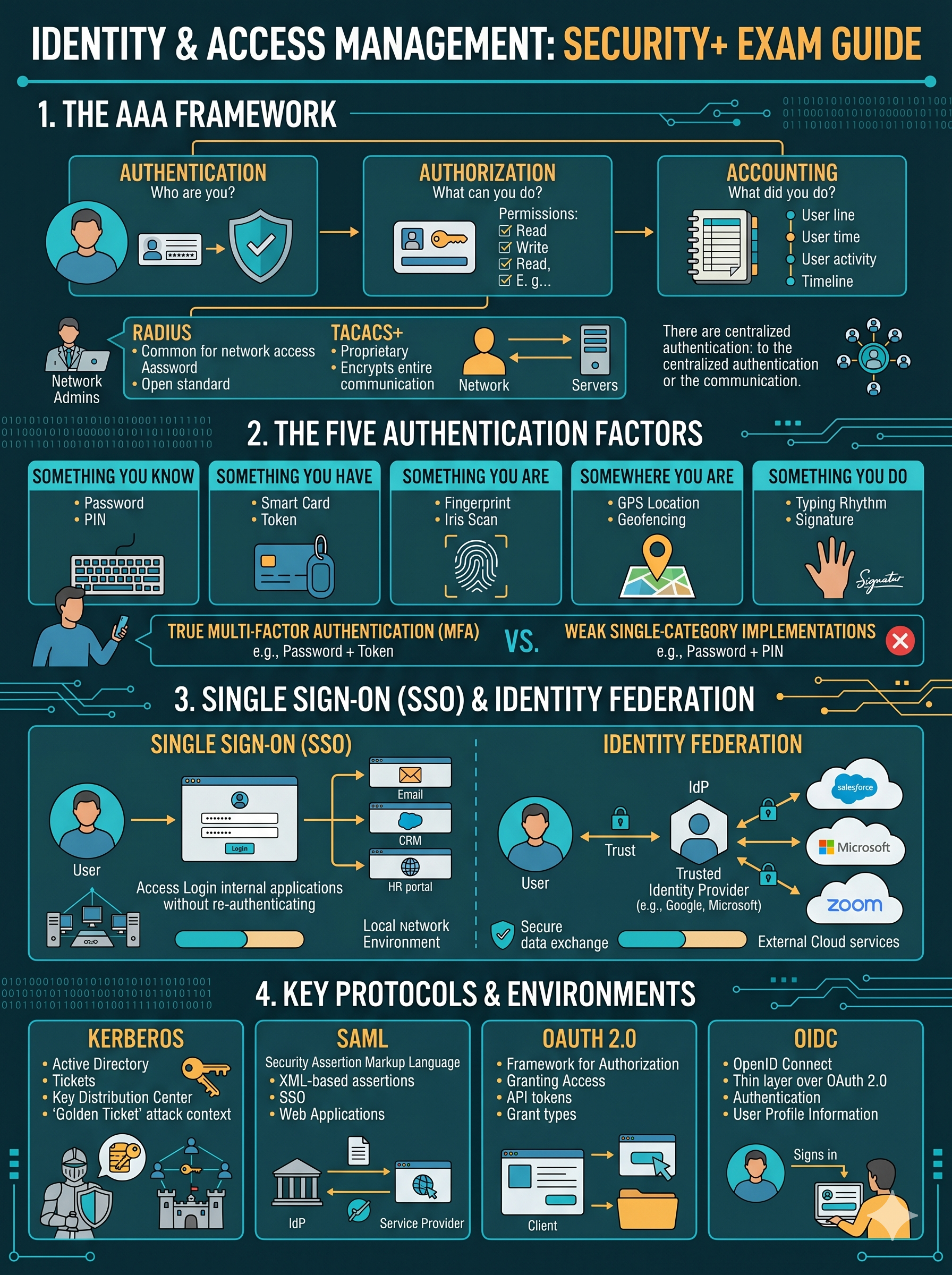
Every enterprise access decision is governed by the AAA framework. Before any resource is accessed, a system must answer three questions: who is this user? what are they allowed to do? and what did they do while they were here? Authentication, Authorization, and Accounting each answer one of these questions.

Analogy — Hotel Check-In: AAA maps perfectly to checking into a hotel. Presenting your ID at the front desk is Authentication — proving you are who you claim to be. Getting a room-specific key card that only opens your floor's elevator and your room is Authorization — you are granted access to only what you are entitled to. The hotel's electronic lock system recording every time your card is used (and when) is Accounting — an audit trail of your activity. If any of the three fail, security breaks down.

The AAA Framework

🔐 Authentication — Proving Identity

The process of verifying that a user, device, or system is who or what it claims to be. Authentication happens before any authorization decision can be made.

  • What it answers: Are you who you say you are?
  • Methods: Passwords, biometrics, certificates, hardware tokens, smart cards
  • Protocols: Kerberos, LDAP, RADIUS, TACACS+, SAML, OAuth
  • Failure risk: Credential theft, brute force, phishing, credential stuffing

🛡️ Authorization — Granting Rights

Determining what an authenticated identity is permitted to do. Authorization is not the same as authentication — a fully authenticated user may still be denied access if they lack the required permissions.

  • What it answers: What are you allowed to do?
  • Models: RBAC, ABAC, MAC, DAC
  • Principle: Least Privilege — grant only the minimum permissions required
  • Common failure: Over-provisioning, privilege creep, excessive group memberships

📋 Accounting — Recording Activity

Logging and auditing what authenticated, authorized users actually do — creating the audit trail that supports forensic investigation, compliance reporting, and insider threat detection.

  • What it answers: What did you do while you were here?
  • Outputs: Audit logs, SIEM events, session recordings, access reports
  • RADIUS vs. TACACS+: Both implement AAA. TACACS+ separates the three functions and encrypts the entire payload — preferred for network device administration. RADIUS encrypts only the password field.

The Five Authentication Factor Types

🔑 Factor Types — MFA Requires Different Categories

MFA is not simply "two passwords." It requires credentials from two or more distinct factor categories. Combining factors from the same category is two-step verification, not true multi-factor authentication.

Type 1 — Something you KNOW: Password, PIN, passphrase, security question. Most common; most attacked.
Type 2 — Something you HAVE: TOTP authenticator app, FIDO2 hardware key (YubiKey), smart card, RSA token, PIV card.
Type 3 — Something you ARE: Fingerprint, iris scan, facial recognition, voice recognition (biometrics).
Type 4 — Something you DO: Keystroke dynamics, gait analysis, mouse movement patterns (behavioral biometrics).
Type 5 — Somewhere you ARE: GPS geolocation, IP address geolocation, network context (connected to corporate Wi-Fi).

⚠️ MFA Exam Traps & Attack Resistance

Password + PIN = NOT MFA — both are Type 1 (Something you know). Two facts are not two factors.

Password + SMS code = Weak MFA — SMS is Type 2 but vulnerable to SIM-swapping. Attackers convince the mobile carrier to transfer your number to a SIM they control.

Password + TOTP app = Strong MFA — Time-based One-Time Passwords generated locally are not interceptable via SIM-swap.

Password + FIDO2 hardware key = Strongest MFA — Phishing-resistant. The key performs a cryptographic challenge-response that is domain-bound — a fake login page cannot steal a FIDO2 response.

Exam tip: CompTIA frequently asks which combination constitutes MFA. Always verify the factor categories are different. Also know that passwordless authentication (FIDO2/WebAuthn) still qualifies as MFA when it combines device possession with biometric verification.
2

SSO, Federation & Access Control Models

Authenticate once, access many — and choose the right permission model for your organization

Users authenticating to dozens of systems individually creates password fatigue, reuse, and weak credentials. SSO and Federation solve this — but with different scopes and different risk profiles. Access control models determine how permissions are assigned once a user is authenticated.

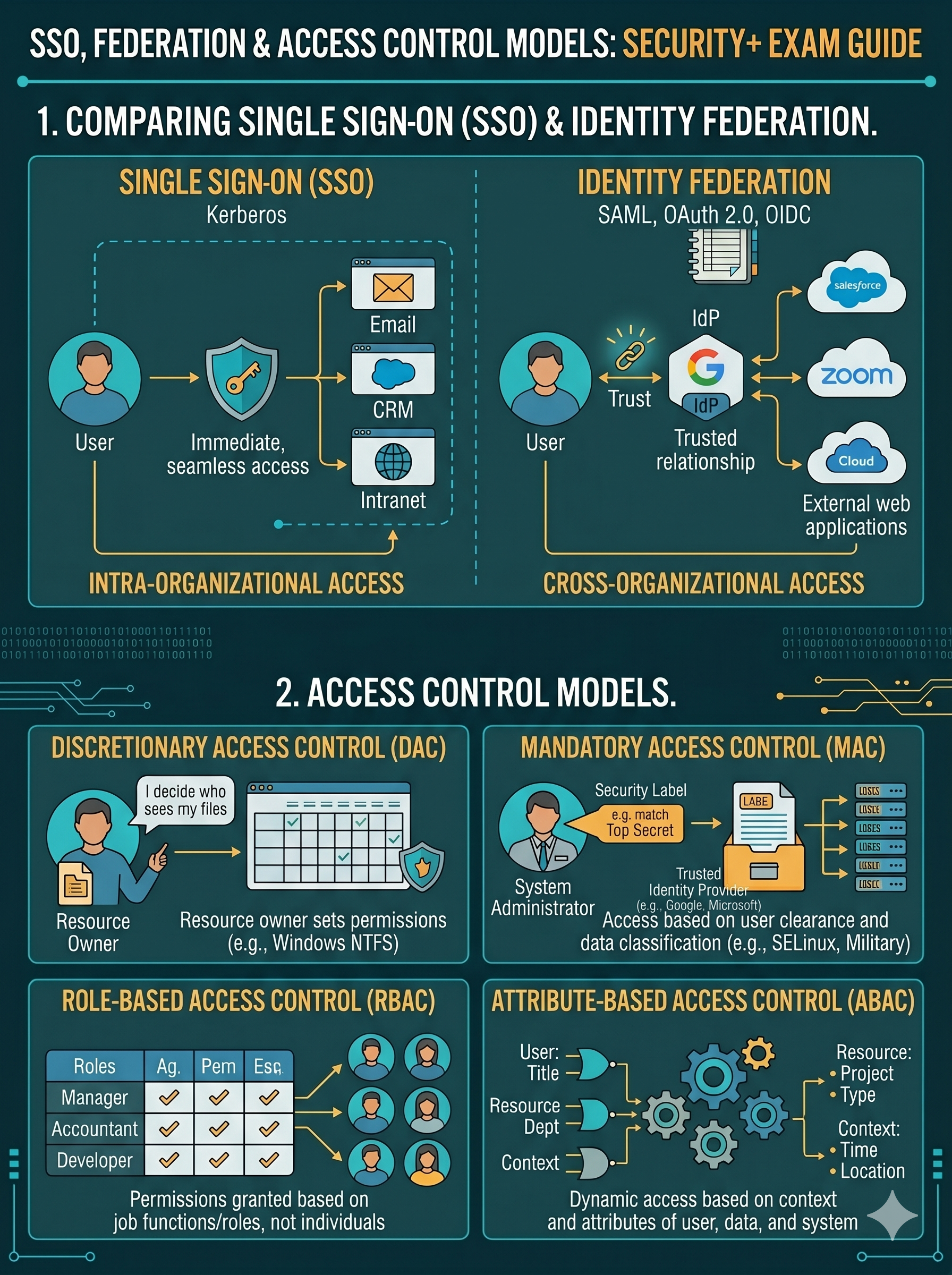
SSO vs. Identity Federation

🏢 SSO — Single Sign-On (Within One Organization)

One authentication event grants access to multiple systems within a single trust boundary — typically an Active Directory domain. The user logs in once; Kerberos tickets or LDAP sessions are used to access integrated internal systems transparently.

  • Protocols: Kerberos (Active Directory), LDAP
  • Scope: Single organization, single domain
  • Benefit: Eliminates password fatigue; reduces password reuse; centralizes authentication management
  • Risk: Single point of failure — if the SSO provider is compromised, all integrated systems are compromised simultaneously. MFA on the SSO login is non-negotiable.

✈️ Federation — Cross-Organizational Identity Trust

Identity trust extended across organizational boundaries — a user authenticates with their home organization's Identity Provider (IdP) and can access external services (Service Providers / SPs) without separate credentials.

  • Protocols: SAML 2.0 (enterprise apps), OAuth 2.0 (API authorization), OpenID Connect / OIDC (authentication layer on OAuth)
  • Example: "Login with Google" — Google is the IdP; the third-party app is the SP
  • Example: University student using campus credentials to access research databases from other institutions
  • Risk: Trust chain attacks — if the IdP is compromised, all federated SPs are compromised
Feature SSO Federation
ScopeSingle organization / domainCross-organization, cloud services
Primary protocolsKerberos, LDAPSAML, OAuth 2.0, OIDC
Key riskSingle point of authentication failureTrust chain compromise via IdP
Best analogyMaster key for all doors in your buildingTSA PreCheck trusted across all airlines

Access Control Models

📋 DAC — Discretionary Access Control

The resource owner decides who has access. Each object (file, folder) has an Access Control List (ACL) that the owner controls.

  • Example: Windows NTFS file permissions — the file owner can grant or revoke access to anyone
  • Strength: Flexible; owner-managed
  • Weakness: Owners may grant too broadly; no central oversight; permissions drift over time

🔒 MAC — Mandatory Access Control

Access is controlled by the system based on security labels and clearance levels. Users cannot override the system's access decisions — even resource owners cannot grant access beyond their clearance level.

  • Example: Military classification systems (Top Secret, Secret, Confidential) — a Secret-cleared user cannot access Top Secret documents even if the TS document owner wants them to
  • Strength: Highest security; no discretion
  • Weakness: Inflexible; complex administration

👥 RBAC — Role-Based Access Control

Permissions are assigned to job roles; users inherit permissions through role membership. Role changes automatically adjust access — the most common model in enterprise environments and the most tested on Security+.

  • Example: Hospital — "Nurse" role has medication dispensing rights; "Billing Clerk" role has financial records access. A nurse promoted to billing manager has their role changed, not individual permissions adjusted.
  • Strength: Scalable; easy to manage; naturally enforces least privilege by job function

🎯 ABAC — Attribute-Based Access Control

Access decisions are based on attributes — characteristics of the user, resource, and environment evaluated at access time. More granular than RBAC.

  • Example: A policy that says "Doctors can access patient records only during their scheduled shift, only from the hospital's network, and only for patients assigned to their department"
  • Strength: Highly granular; dynamic (time, location, context-aware)
  • Weakness: Complex to configure and audit; rule explosion in large environments
Least Privilege & Need-to-Know — The Access Control Foundation: Regardless of which model is used, two principles should always guide access decisions. Least Privilege: grant only the minimum permissions required to perform the specific job function — nothing more. Need-to-Know: even if a user's clearance level permits access, they should only access information relevant to their current duties. A billing clerk may have the clearance to view patient records but has no need-to-know and should not have access. The blast radius of any account compromise is directly limited by how strictly these principles were enforced.
3

Identity Lifecycle & Privileged Access Management

Provisioning, privilege creep, deprovisioning, orphaned accounts, and protecting the crown jewels of the environment

Identity governance answers the question: does the right person still have the right access for the right reason? This question must be answered continuously — not just at hire — because identities change throughout their lifecycle. Privileged accounts demand an additional tier of control because compromising an admin account gives an attacker far greater access than any other initial foothold.

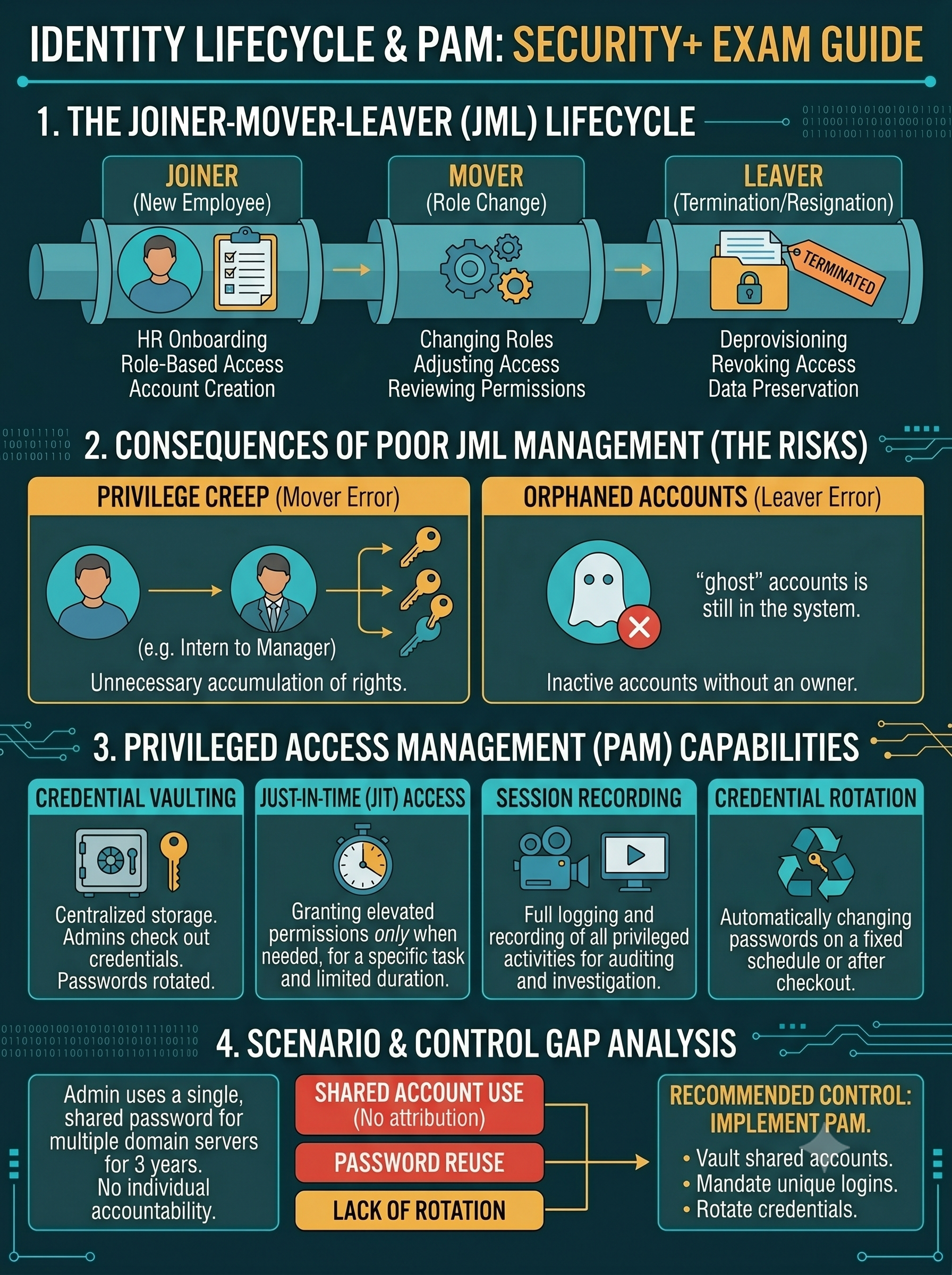
The Joiner-Mover-Leaver Lifecycle

🟢 Joiner — Provisioning New Access

When a new user joins, access should be provisioned through a documented workflow using role-based templates — not manual, ad-hoc assignment. The provisioning process must enforce least privilege from day one.

  • IdP-driven provisioning: Use an Identity Provider (Azure AD, Okta, Google Workspace) with SCIM to automate account creation across all integrated systems
  • Role templates: A "Junior Analyst" template includes exactly the access that role requires — no more
  • Time-bounded access: Contractors receive accounts with automatic expiry dates — the account ceases to function on the last day of the contract
  • Formal approval: Access provisioning requires manager and security approval, documented in a ticketing system for audit evidence

🟡 Mover — Managing Role Changes

When a user transfers departments or changes roles, the correct process is: remove old role access FIRST (or simultaneously), then add new role access. Adding new access without removing old access creates privilege creep — and every mover event compounds it.

  • Privilege creep example: An employee who has worked in IT, Finance, and HR over 5 years may have accumulated all three departments' permissions — a significant insider threat risk
  • Access reviews (recertification): Periodic formal review where managers certify that each employee's current access is still appropriate — quarterly for privileged access, annually for standard
  • Separation of duties: Roles should be designed so no single user can complete a high-risk transaction alone (e.g., approving and processing a vendor payment)

🔴 Leaver — Deprovisioning & Orphaned Accounts

Deprovisioning is time-critical. The moment an employee's departure is known — whether voluntary resignation or termination — the deprovisioning process should begin immediately, not wait until their final physical day. The correct order of operations:

Immediate actions (same day as departure notice):

  • Disable the account (not delete — preserve forensic access)
  • Revoke all active sessions and cached tokens
  • Revoke VPN, remote access, and cloud credentials
  • Remove from privileged groups immediately
  • Notify IT and security teams

Post-departure (within 30 days):

  • Archive email and file data per retention policy
  • Transfer ownership of critical files/systems
  • Review audit logs for anomalous pre-departure activity
  • Delete the account after retention period expires
  • Update emergency contact lists and documentation
Orphaned Account Risk: An orphaned account is an active account with no current legitimate owner — typically from a departed employee, a project that ended, or a contractor whose engagement concluded. Orphaned accounts are among the most attractive targets for attackers: they have legitimate access, generate no unusual behavior alerts (no legitimate owner to notice suspicious activity), and may have accumulated permissions never formally reviewed.

Privileged Access Management (PAM)

🏦 Why PAM Is Critical

Privileged accounts — domain administrators, root accounts, service accounts, database administrators — are the highest-value targets in any environment. A threat actor who obtains a privileged credential gains the ability to access or modify any system that account can reach. Standard MFA and access controls are insufficient — privileged accounts require their own security tier.

  • Domain admin credentials enable access to every Windows system in the domain
  • Service accounts often have excessive permissions and never expire
  • Privileged accounts are primary targets for Pass-the-Hash, Kerberoasting, and credential stuffing
  • Manual credential management creates inconsistency and audit gaps

🔐 PAM Core Capabilities

  • Credential Vaulting: All privileged passwords are stored in an encrypted vault — admins never see the actual password; they check out a session. Eliminates password-sharing and credential theft via screenshot or keylogger
  • Just-in-Time (JIT) Access: Privileged access exists only for the duration of a specific approved task — 15 minutes, 2 hours — then automatically expires. Eliminates persistent admin credentials
  • Session Recording: Full video capture and keystroke logging of every privileged session — evidence for forensic investigation and compliance audits. Admins who know their sessions are recorded self-police
  • Credential Rotation: Passwords are automatically changed after each use or on a defined schedule. Defeats Pass-the-Hash and replay attacks — even if a hash was captured, the underlying password has already changed
Analogy — The Bank Vault Key: Think of PAM like accessing a bank vault. You don't get to keep the vault key — you check it out from the key custodian (credential vaulting), your access window is scheduled for a specific 15-minute window (JIT access), two authorized witnesses are present and the entire access is video-recorded (session recording), and the vault combination is changed the moment you leave (credential rotation). No single person has unchecked, persistent, unobserved access to the vault. PAM applies this same rigor to your most sensitive IT systems.
Activity 1

IAM Concept Sort — Drag & Drop

Classify each IAM control or concept into its correct category

Instructions: Each chip describes an IAM control, scenario, or technique. Drag it to the category it BEST belongs to. Submit for graded feedback. Click × to return a chip to the pool.
FIDO2 hardware security key
Nurse role grants medication access
SIEM logs every privileged login
JIT access expires after 15 minutes
Contractor account auto-expires on last day
Fingerprint + PIN login to workstation
MAC clearance label controls file access
Admin password rotated after every session
Disabling account immediately on resignation
Session recording of DBA database changes
Authentication
Authorization
Accounting
PAM
Identity Lifecycle
Activity 2

IAM Scenario Analyzer

Select a real-world IAM scenario and identify the correct control, failure type, or remediation

Instructions: Select a scenario tab. Read the situation, then answer each question individually for graded feedback with detailed explanations.
🟡 Scenario A: Five Years of Accumulated Access
During a quarterly access review at a regional bank, the IAM team discovers that Sarah, a senior analyst, has accumulated the following access rights over her 5-year career: (1) read access to the trading floor network from her first role in IT support, (2) write access to the loan origination database from her second role in lending, (3) full admin rights to the HR management system from a 6-month project deployment, and (4) her current role's permissions as a financial compliance analyst. Sarah's manager confirms she only needs the compliance analyst permissions for her current role.
Q1: What IAM failure does this scenario describe, and what is the MOST direct remediation?
Q2: Which process, if properly implemented during each of Sarah's role changes, would have PREVENTED this situation?
🔴 Scenario B: The Forgotten Contractor
Six months after a penetration test engagement ended, the security team discovers that the external penetration testing firm's service account still has active VPN credentials and read access to three network segments, including the segment containing the PCI-scoped payment processing servers. A review of VPN logs shows no activity on this account in 5 months. The original project manager who contracted the pen test firm has since changed departments, and nobody currently owns the relationship with that vendor.
Q1: What type of account does this service account represent, and what is the CORRECT immediate action?
🔵 Scenario C: The Always-On Admin Account
A financial services company's four database administrators (DBAs) each have their own persistent domain admin accounts that they use for all daily tasks — including reading email, browsing the web, and conducting database maintenance. These accounts never expire. Passwords were last changed 14 months ago. There is no session recording on any database connections made with these credentials. During a recent tabletop exercise, the IR team realized that if any DBA's credentials were compromised (via phishing, for example), an attacker would immediately have full domain admin access across the entire environment.
Q1: Which PAM implementation BEST addresses the security risks described in this scenario?
Assessment

Knowledge Check: Identity & Access Management

Select the best answer for each question, then submit for graded feedback
Question 1 of 5
A user logs into their corporate laptop by entering a PIN, then approving a push notification on their registered smartphone. The security team claims this is Multi-Factor Authentication. Is this claim correct, and why?
Question 2 of 5
A university wants its students to access research databases hosted by partner institutions using their campus credentials. Which technology BEST enables this cross-organizational identity trust?
Question 3 of 5
A healthcare organization stores patient records classified at different sensitivity levels. Access to Top Secret-equivalent patient records cannot be granted by department managers — only the system's classification labels determine access, and no user can override these decisions. Which access control model is the organization using?
Question 4 of 5
A security audit reveals that a database administrator (DBA) used their persistent domain admin account to approve their own vacation request, order office supplies, read personal email, and perform database maintenance — all with the same credential on the same workstation. Which two security principles are MOST clearly violated by this arrangement?
Question 5 of 5
An organization is onboarding a third-party cloud migration consultant who needs temporary access to specific AWS S3 buckets for 45 days. The consultant will work remotely. Which combination of IAM controls BEST addresses this scenario from a Security+ perspective?