S+

CompTIA Security+ SY0-701

Lesson 5 of 12 — Secure Architecture

Day 5 ← Course Home ← Lesson 4
Lesson 5 — Security Architecture (18% of exam)

Secure Architecture

On-premises and cloud design, virtualization, IoT, ICS, Infrastructure as Code, data classification, redundancy, and high availability — how security is built into systems from the ground up, not bolted on afterward.

📖 3 Topics 🎯 2 Activities 📝 5-Question Quiz ⏱ ~60 min Domain: Security Architecture

By the end of this lesson, you will be able to:

  • Compare secure architecture design principles across on-premises, cloud, hybrid, and edge computing environments.
  • Explain the security implications of virtualization, including hypervisor types, VM escape risks, and container isolation challenges.
  • Describe the unique security challenges of IoT devices and recommend controls that address their constrained, always-on nature.
  • Distinguish ICS/SCADA environments from traditional IT networks and justify why standard IT security practices must be adapted for operational technology.
  • Explain how Infrastructure as Code (IaC) enables consistent, auditable, and version-controlled security configuration at scale.
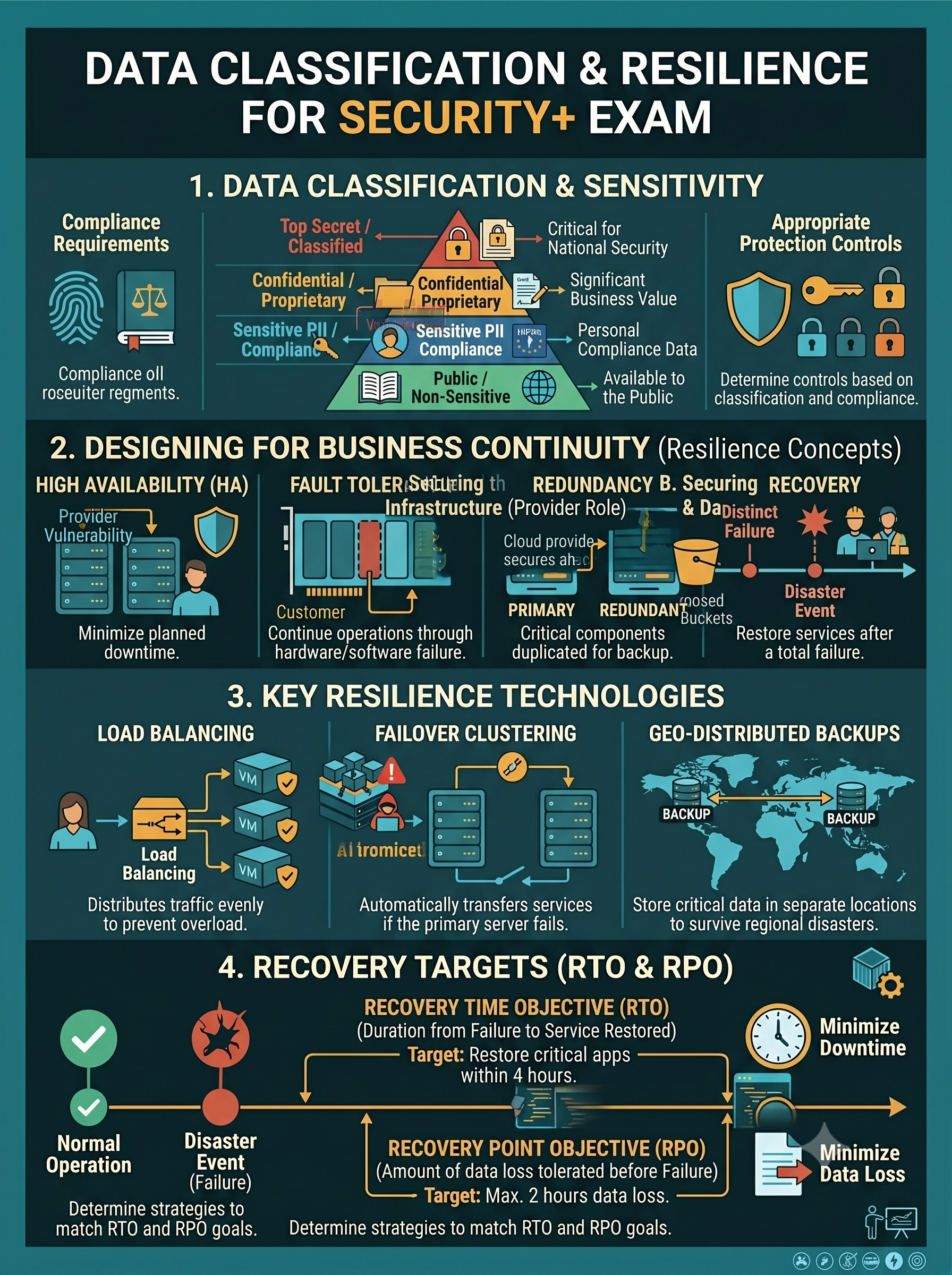
  • Apply a data classification scheme to categorize organizational data assets and recommend appropriate protection controls for each tier.
  • Define redundancy, high availability, and fault tolerance, and design a resilience solution for a described business continuity scenario.
IoT (Internet of Things)
The network of physical devices — sensors, cameras, HVAC systems, medical equipment, industrial controllers — embedded with software that enables them to connect to the internet and exchange data. IoT devices typically have limited computing resources and minimal built-in security.
ICS (Industrial Control System)
Systems used to monitor and control physical industrial processes — power generation, water treatment, manufacturing, pipelines. ICS includes SCADA (Supervisory Control and Data Acquisition) systems. Availability is the paramount security concern; downtime can have physical safety consequences.
IaC (Infrastructure as Code)
The practice of managing and provisioning computing infrastructure through machine-readable configuration files rather than manual processes. Enables version control, automated testing, consistent deployment, and audit trails for all infrastructure changes.
Redundancy
The duplication of critical components or systems so that if one fails, the duplicate can take over without service interruption. Redundancy directly supports the Availability pillar of the CIA triad and is a foundational resilience concept.
High Availability (HA)
A system design characteristic that ensures a high level of operational uptime — typically 99.9% (three nines) or above. HA is achieved through redundant components, failover clustering, load balancing, and geographic distribution. Measured and expressed as a percentage of annual uptime.
Defense in Depth
A security architecture strategy that layers multiple independent security controls so that the failure of any single control does not lead to a complete system compromise. Also called layered security — each layer slows or stops an attacker who has defeated the previous layer.
Data Classification
The process of categorizing organizational data by its sensitivity, value, and the potential impact of unauthorized disclosure. Classification tiers (e.g., Public, Internal, Confidential, Top Secret) drive appropriate protection requirements, handling procedures, and access controls.
Zero Trust Architecture
A security model that eliminates the concept of implicit trust within a network perimeter. Every user, device, and workload must continuously authenticate and be authorized for every resource access — regardless of network location. "Never trust, always verify."

In the previous lessons, you identified threats (Lesson 3) and vulnerabilities (Lesson 4). This lesson addresses the foundational question those lessons implied: how do you design systems so they are inherently harder to attack? Secure architecture is the discipline of building security into systems from the beginning — not as an afterthought. A well-architected environment contains an attacker, limits the blast radius of any breach, and recovers automatically from failures before users are impacted.

The Security Architecture domain carries 18% of the Security+ exam and spans an unusually broad range — from the specific security controls of a cloud VPC to the existential safety risks of a compromised water treatment ICS. The thread connecting all of it is a set of principles: separation, segmentation, least privilege, redundancy, and verification at every layer. By the end of this lesson, you will be able to look at an architectural scenario and identify both the risks and the design decisions that mitigate them.

01

On-Premises, Cloud & Virtualization

Secure design principles across physical data centers, cloud environments, and virtualized infrastructure — including hypervisor security and container isolation.

🔄 Click to flip

On-Premises, Cloud & Virtualization

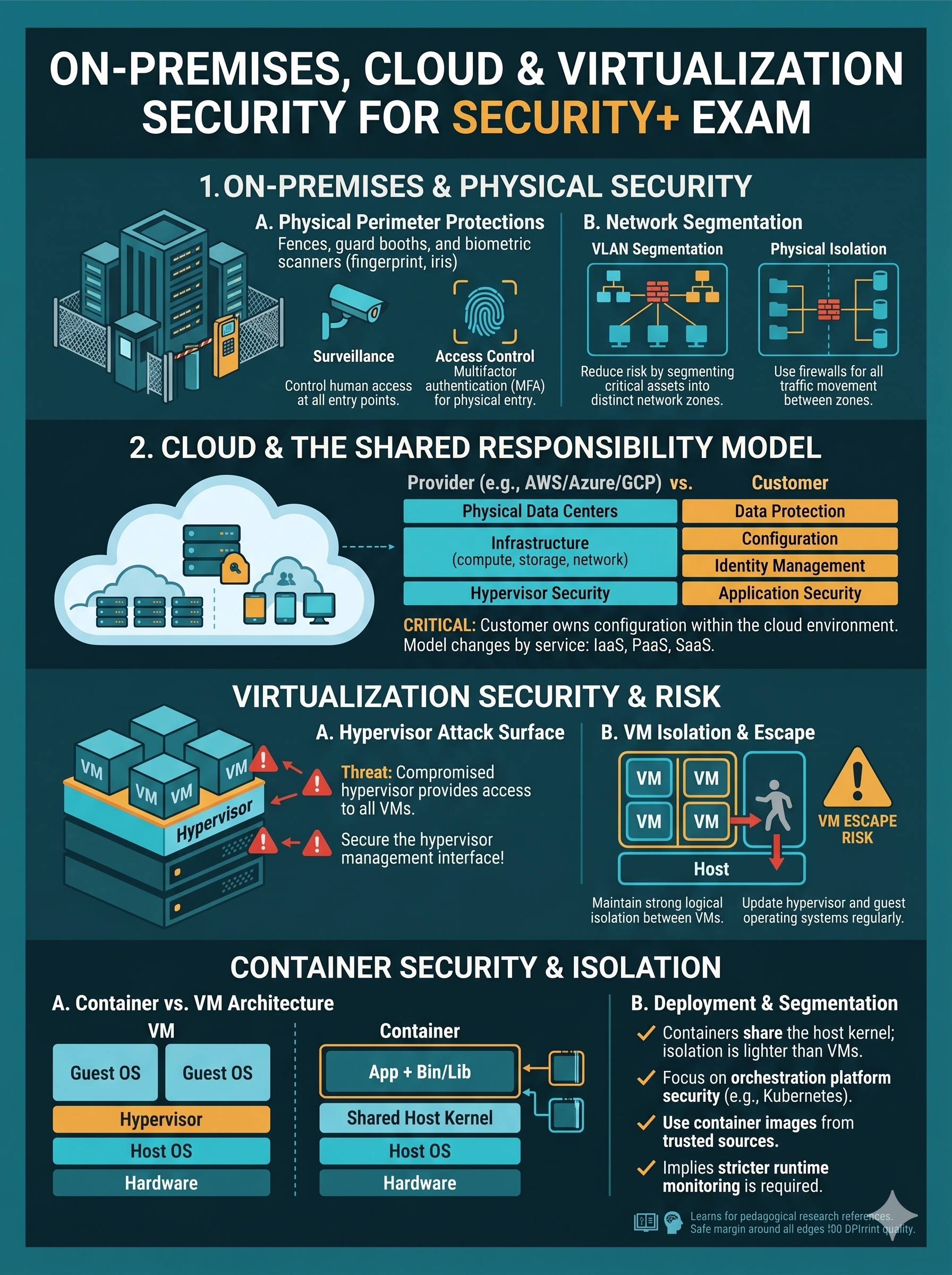
On-premises relies on physical perimeter controls + network segmentation. Cloud requires the Shared Responsibility Model: customer owns configuration. Virtualization introduces hypervisor attack surface and VM escape risk. Containers share the host kernel — isolation is lighter than VMs.

02

IoT, ICS & Infrastructure as Code

The unique security challenges of always-on embedded devices, safety-critical industrial systems, and the transformative role of IaC in automating secure configuration.

🔄 Click to flip

IoT, ICS & IaC

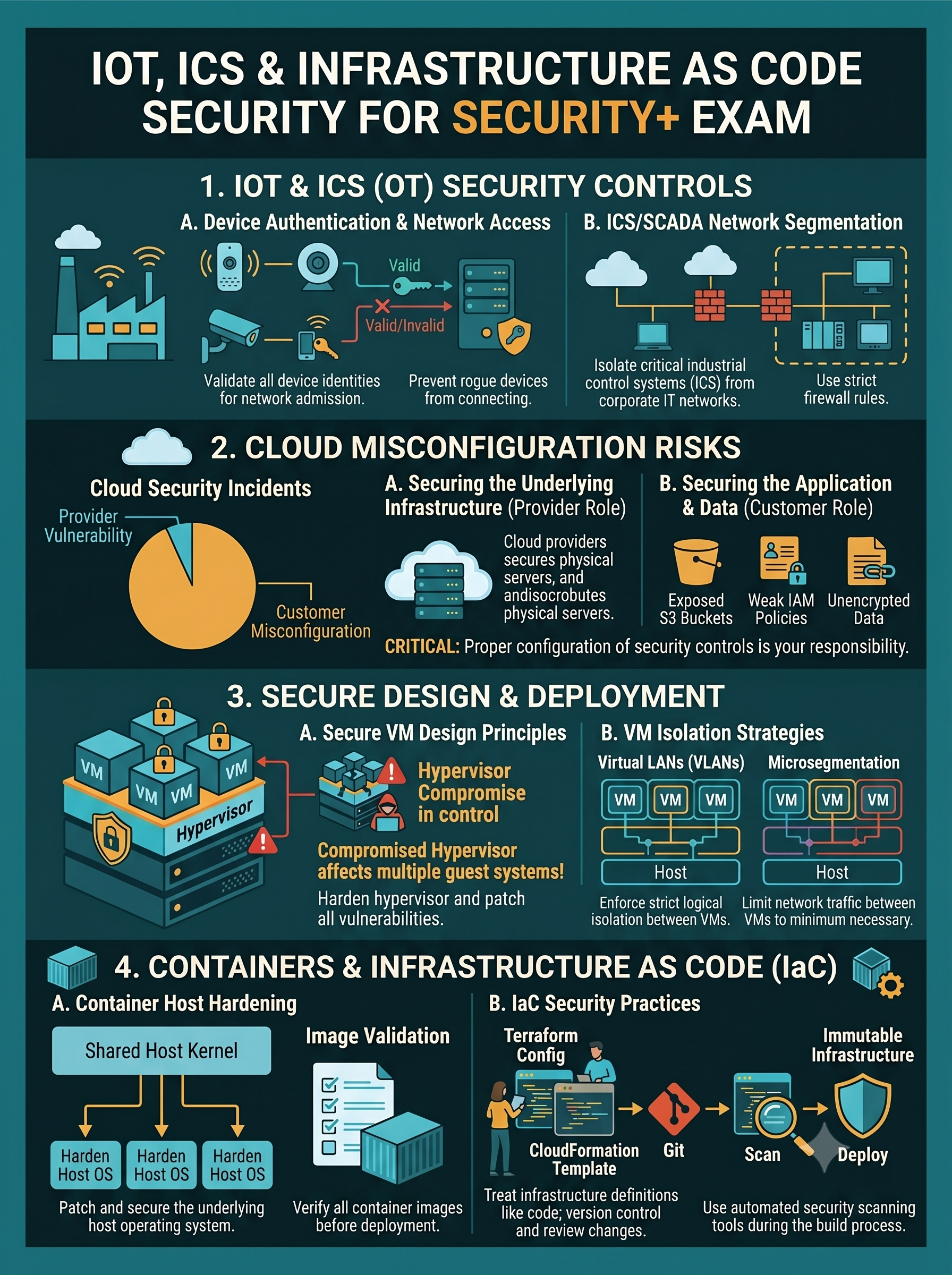
IoT devices have weak security, long lifecycles, and no patch cadence — segment and monitor. ICS prioritizes Availability over CIA; Stuxnet proved physical damage is achievable through cyber means. IaC enforces consistent, version-controlled, auditable infrastructure configuration — eliminating "snowflake" servers.

03

Data Classification & Resilience

Classifying data to drive appropriate protection levels — plus redundancy, high availability, fault tolerance, and recovery concepts that keep businesses running through failures.

🔄 Click to flip

Data Classification & Resilience

Data classification determines what protection an asset needs. HA and resilience ensure it stays accessible — achieved through redundant power, failover clustering, geo-distributed backups, load balancing, and documented RTO/RPO targets. The architecture must survive component failures without human intervention.

1

On-Premises, Cloud & Virtualization Security

Secure design principles across physical and virtual infrastructure — and where responsibility lies

The first architectural decision — where does this infrastructure live? — determines the entire security model. On-premises environments put you in full control; cloud environments shift some responsibility to the provider. Both models demand deliberate security design, but the attack surface, controls, and ownership differ significantly.

On-Premises Architecture Security

🏢 Physical Perimeter & Layered Zones

On-premises security begins at the building perimeter and works inward. Defense in depth layers physical controls (badge readers, mantraps, CCTV) with network controls (firewalls, VLANs, IDS/IPS) and logical controls (ACLs, encryption, MFA).

  • DMZ: Internet-facing servers (web, email, DNS) placed between two firewalls — separate from the internal network
  • Screened subnet: A variation of the DMZ where a single firewall creates a three-interface topology (internet / DMZ / internal)
  • Air-gapped networks: Physically isolated from all other networks — used for classified, ICS, or extremely sensitive environments

🌐 Network Segmentation Architecture

Flat networks are a security anti-pattern — a single compromised endpoint can reach every other system. Segmented architectures contain lateral movement and enforce access control between zones.

  • VLANs: Logical separation at Layer 2 — user, server, management, guest, IoT each in dedicated VLANs
  • Micro-segmentation: Zero-trust network where every workload is isolated; east-west traffic requires explicit authorization
  • Jump server / bastion host: Single, hardened access point for admin access to sensitive network segments — all admin sessions route through it and are logged
  • Proxy servers: Inspect and filter outbound traffic — web proxies, forward proxies, CASB for cloud app control
Analogy — The Hospital Floor Plan: Think of on-premises network architecture like a hospital. The lobby is publicly accessible (DMZ / internet-facing services). The wards require a badge (internal network). The operating theater requires surgical credentials and a sterile gown (privileged management network). The pharmacy has its own key system even within the building (PAM / privileged access segment). Each zone enforces the minimum access needed for each role — and moving between zones requires explicit authorization at each boundary.

Cloud Architecture Security — Shared Responsibility Model

☁️ The Shared Responsibility Model

Cloud security is a partnership. The provider (AWS, Azure, GCP) is responsible for securing the cloud — physical hardware, hypervisors, global network infrastructure. The customer is responsible for securing what is in the cloud — OS configuration, application code, IAM policies, data encryption, and network controls.

  • IaaS: Provider owns physical + hypervisor. Customer owns OS upward — all software patching, configuration, and security controls
  • PaaS: Provider owns OS + runtime. Customer owns application code and data
  • SaaS: Provider owns everything except data classification and user access management
  • Exam tip: Most cloud breaches are the customer's fault — misconfiguration, not provider failure

🏗️ Secure Cloud Design Patterns

Cloud-native architectures require security controls that match their dynamic, ephemeral nature:

  • Private subnets: Database and application tiers in private subnets with no direct internet route
  • Security groups / NACLs: Stateful (SG) and stateless (NACL) firewall controls at the resource and subnet level
  • VPC peering & endpoints: Private connectivity between VPCs and to AWS services without traversing the public internet
  • Encryption everywhere: Server-side encryption for S3, RDS, EBS; TLS in transit; KMS for key management
  • Immutable infrastructure: Servers are never patched in-place — they are replaced with new, patched instances from a golden AMI

Virtualization Security

🖥️ Hypervisor Types & Risk

Type 1 (Bare-metal): Runs directly on hardware (VMware ESXi, Hyper-V, Xen). More secure — no host OS attack surface. Used in production data centers and cloud providers.

Type 2 (Hosted): Runs as an application on a host OS (VirtualBox, VMware Workstation). Less secure — host OS vulnerabilities affect all VMs. Used for development and testing.

  • Hypervisor patching is critical — a hypervisor vulnerability affects every VM on that host simultaneously

⚠️ VM Escape & Sprawl

VM Escape: An attacker who has compromised a guest VM exploits a hypervisor vulnerability to break out and access the host or other VMs. Extremely serious — escaping the VM boundary compromises the entire host's workload.

VM Sprawl: Uncontrolled proliferation of VMs — including forgotten, unpatched VMs that become persistent attack surfaces. Requires inventory management and lifecycle policies.

📦 Container Security

Containers (Docker, Kubernetes) share the host OS kernel — lighter than VMs but with a smaller isolation boundary. A container escape is less dramatic than a VM escape but still gives access to the host filesystem.

  • Never run containers as root
  • Use read-only filesystems where possible
  • Scan container images for CVEs before deployment (Trivy, Snyk)
  • Use namespaces and seccomp profiles to restrict syscalls
  • Kubernetes RBAC controls who can deploy and modify workloads
Zero Trust Architecture (ZTA) — The Modern Standard: Traditional perimeter security assumes that anything inside the network can be trusted. Zero Trust rejects this assumption: "Never trust, always verify." Every user, device, and workload must authenticate and be authorized for every resource request, regardless of whether they are inside or outside the traditional network perimeter. This model was mandated for U.S. federal agencies by Executive Order 14028 (2021) and is the direction of all modern enterprise security architecture. Key ZTA tenets: verify explicitly, use least-privilege access, assume breach.
2

IoT, ICS & Infrastructure as Code

Securing embedded devices, industrial systems, and configuration at machine speed

These three topics represent the expanding frontiers of what "infrastructure" means. IoT brought the internet to every light bulb and thermostat. ICS connects digital controls to physical processes. IaC turned infrastructure configuration into software — with all of software's security implications. Security+ tests all three.

IoT Security Challenges

📡 Why IoT Is a Security Problem

IoT devices are designed for functionality and cost, not security. They are shipped with minimal security features, rarely updated, and typically deployed in large numbers across environments that were not designed to accommodate them.

  • Default credentials: Most IoT devices ship with default admin/password — Mirai botnet compromised 600,000 devices this way in 2016
  • No patch mechanism: Many IoT devices have no update capability; firmware vulnerabilities persist for the device's entire lifecycle (often 10–20 years)
  • Limited compute: Insufficient processing power for standard encryption or security agents
  • Always-on connectivity: IoT devices maintain persistent connections — a compromised device is a persistent foothold
  • Physical access: Devices deployed in physically accessible locations (parking lots, lobbies) can be tampered with directly

🛡️ IoT Security Controls

Standard IT security controls cannot always be applied to IoT devices — you cannot install an EDR agent on a smart thermostat. Security must be implemented at the network and architectural level instead.

  • Network segmentation: IoT devices belong in a dedicated, isolated VLAN. They should never be on the same network segment as corporate workstations or servers
  • Change default credentials: The first step before any IoT device goes online — change every default username and password
  • Firmware updates: Enable automatic updates where available; track firmware versions in an asset inventory
  • NAC (Network Access Control): Only allow authorized, inventoried devices to connect to the IoT VLAN
  • Monitoring: Baseline normal IoT device traffic; alert on anomalies (a thermostat scanning ports is a red flag)
  • Decommissioning: Physically destroy IoT devices at end-of-life — storage chips may contain sensitive data

ICS / SCADA Security

⚙️ What Makes ICS Different

Industrial Control Systems manage physical processes — power generation, water treatment, oil pipelines, manufacturing lines, building management. In ICS, a security failure is not just a data breach — it can cause physical harm, environmental damage, or loss of life.

  • Availability first: The CIA triad is inverted for ICS — Availability > Integrity > Confidentiality. A water treatment plant that goes offline causes a public health emergency
  • Legacy systems: ICS components often run for 20–30 years on proprietary, unpatched operating systems. Many use Windows XP or earlier
  • Proprietary protocols: Modbus, DNP3, OPC — designed for reliability, not security. Most have no authentication or encryption
  • Real-time constraints: Latency introduced by security controls (scanning, encryption) can disrupt time-critical physical processes

🏭 ICS Security Controls

Security in OT/ICS environments must be adapted to the operational constraints — controls that would be standard in IT can cause outages in ICS.

  • IT/OT network separation: The ICS network must be isolated from the corporate IT network — either air-gapped or connected through a unidirectional security gateway (data diode)
  • Data diode: Hardware that allows data to flow in only one direction — OT data can be sent to IT for monitoring, but no traffic can flow back
  • Purdue Model / ICS-62443: Reference architecture that defines security zones from the enterprise network down to the physical process level
  • Patch management: Patches must be tested on identical lab systems before production — unplanned downtime in ICS can have safety consequences
  • Vendor remote access: Third-party ICS vendors often need remote access for maintenance — must be controlled, time-limited, and monitored
Stuxnet (2010): The first nation-state cyberweapon to cause physical damage. It targeted Siemens PLCs at Iranian uranium enrichment facilities, causing centrifuges to spin out of tolerance while reporting normal operation. It demonstrated that ICS systems could be weaponized through cyber means.

Infrastructure as Code (IaC)

📄 What IaC Solves

Before IaC, infrastructure was configured manually — leading to "snowflake servers" (unique configurations that no one fully understood), configuration drift (servers that slowly diverge from their intended state), and undocumented changes that created vulnerabilities.

  • Consistency: Every server deployed from the same IaC template is identically configured — no manual variation
  • Version control: Infrastructure configuration is stored in Git — every change is tracked, attributable, and reversible
  • Security scanning: IaC templates can be scanned for misconfigurations before deployment (tfsec for Terraform, cfn-lint for CloudFormation)
  • Immutable infrastructure: Instead of patching a running server, deploy a new instance from a patched, validated template and retire the old one
  • Audit trail: Git commit history provides a complete audit trail of all infrastructure changes — who changed what, when, and why

💻 IaC Tools & Security Patterns

Common IaC platforms tested on Security+:

  • Terraform (HashiCorp): Cloud-agnostic — provisions infrastructure across AWS, Azure, GCP from declarative configuration files (.tf)
  • AWS CloudFormation: AWS-native IaC — defines entire stacks (VPC, EC2, RDS, IAM) as JSON/YAML templates
  • Ansible: Configuration management — applies and enforces desired system state across servers
  • Kubernetes manifests: Declarative YAML defines container workloads, network policies, and RBAC

Example IaC security pattern — S3 bucket with encryption enforced:

# Terraform — S3 bucket with encryption & no public access resource "aws_s3_bucket" "secure_bucket" { bucket = "corp-data-archive" } resource "aws_s3_bucket_public_access_block" "block" { bucket = aws_s3_bucket.secure_bucket.id block_public_acls = true block_public_policy = true restrict_public_buckets = true } resource "aws_s3_bucket_server_side_encryption_configuration" "enc" { bucket = aws_s3_bucket.secure_bucket.id rule { apply_server_side_encryption_by_default { sse_algorithm = "aws:kms" } } } # Security scan (tfsec) runs on this file in CI/CD pipeline # before ANY infrastructure change reaches production
IaC Security Risk — Secrets in Code: The most common IaC security mistake is embedding secrets (API keys, database passwords, access tokens) directly in IaC configuration files that are committed to version control. Even private repositories are not safe if they become public accidentally. Secrets belong in dedicated secrets management systems (AWS Secrets Manager, HashiCorp Vault, Azure Key Vault) — IaC references the secret by name, never by value.
3

Data Classification & Resilience

Protecting the right data the right way — and building systems that stay up when components fail

Not all data deserves the same protection. Applying top-secret-level controls to a public press release wastes resources; applying public-level controls to financial records invites breach. Data classification aligns protection cost with data value. Resilience architecture ensures classified data remains available to authorized users even when individual components fail.

Data Classification Frameworks

Government/Military Classification — used by federal agencies and defense contractors (DoD 5200.01):

Top Secret
Top Secret

Unauthorized disclosure could cause exceptionally grave damage to national security. Access requires TS clearance + Special Access Program (SAP) authorization. Examples: nuclear weapon designs, intelligence collection methods.

Secret
Secret

Unauthorized disclosure could cause serious damage to national security. Requires Secret clearance. Examples: military operational plans, diplomatic cables, foreign intelligence reports.

Confidential
Confidential

Unauthorized disclosure could cause damage to national security. Requires Confidential clearance. Examples: personnel records, unclassified intelligence with sensitive source information.

Unclassified
Unclassified / Public

No classification required. Safe for public release. Examples: press releases, published research, public-facing websites.

Commercial/Corporate Classification — used in private sector organizations:

Restricted
Restricted / Confidential

Highest sensitivity. Disclosure would cause severe competitive or legal harm. Examples: trade secrets, M&A plans, source code, cryptographic keys, cardholder data (PCI), PHI (HIPAA), SSNs.

Internal / Private
Internal / Private

For use by employees only. Disclosure would be inappropriate but not catastrophic. Examples: internal policies, project plans, salary data, employee performance reviews, internal IP addresses.

Sensitive
Sensitive

Requires protection but is shared with partners, contractors, or approved third parties. Examples: contracts, financial statements shared with auditors, partner integration credentials.

Public
Public

Safe for unrestricted distribution. No access control required. Examples: marketing materials, job postings, published documentation, public APIs.

Classification Drives Controls: Data classification is not just a labeling exercise — it directly determines which encryption standards apply, who can access the data, how it must be stored and transmitted, how long it is retained, and how it must be destroyed. A healthcare organization that classifies patient records as PHI must apply HIPAA-required controls to that specific classification tier and can apply lighter controls to de-identified research data.

Resilience, Redundancy & High Availability

Measuring Availability — The Nines

High availability is measured and contractually specified as a percentage of annual uptime. Understanding the nines is essential for architecture decisions:

99% (Two nines)
~87 hrs/yr down
99.9% (Three nines)
~8.7 hrs/yr down
99.99% (Four nines)
~52 min/yr down
99.999% (Five nines)
~5 min/yr down

Five nines (99.999%) is the gold standard for telecom and critical infrastructure — it allows only ~5 minutes of downtime per year. Each additional nine requires exponentially more redundancy and typically costs an order of magnitude more to achieve.

🔁 Redundancy Patterns

Redundancy eliminates single points of failure by duplicating critical components:

  • Active-Active clustering: Both nodes handle traffic simultaneously. Capacity doubles; failover is instant (no takeover time needed)
  • Active-Passive clustering: Primary handles all traffic; secondary is on standby. Failover requires a brief switchover but provides a clean separation of roles
  • RAID (storage): RAID 1 (mirror), RAID 5 (parity), RAID 10 (mirror + stripe) — different tradeoffs between redundancy, performance, and cost
  • Redundant power: Dual PSUs in servers, UPS (minutes to hours), generator (days); redundant utility feeds from separate substations
  • Geographic redundancy: Multi-region deployments protect against entire data center failures (natural disasters, regional outages)

⚖️ Load Balancing & Failover

Load balancers distribute traffic across multiple backend servers — providing both performance and resilience:

  • L4 load balancing: Routes based on TCP/UDP port — fast, no application awareness
  • L7 load balancing: Routes based on HTTP content (URL, headers, cookies) — enables sophisticated routing and SSL termination
  • Health checks: Load balancer periodically tests backend health; removes unhealthy servers from rotation automatically
  • Geographic load balancing: Routes users to the nearest data center (CDN-style); DNS-based failover redirects traffic if a region fails
  • Anycast: Multiple servers share the same IP address; routing infrastructure sends packets to the nearest one

🎯 RTO & RPO — Recovery Targets

Two critical metrics define what an organization can tolerate in a disaster:

  • RTO (Recovery Time Objective): The maximum acceptable time from failure to full service restoration. RTO of 4 hours means the business can tolerate no more than 4 hours of downtime before significant impact
  • RPO (Recovery Point Objective): The maximum acceptable data loss measured in time. RPO of 1 hour means the most recent backup must be no more than 1 hour old
  • Backup site types: Hot site (fully operational, immediate failover), Warm site (partial infrastructure, hours to activate), Cold site (physical space only, days to activate)
  • Architecture implication: Lower RTO/RPO = more expensive architecture (more redundancy, synchronous replication)

💾 Backup Strategy — 3-2-1 Rule

The industry-standard backup rule that ensures recoverability even in worst-case scenarios:

  • 3 copies of the data
  • 2 different storage media types (e.g., SAN + tape, or disk + cloud)
  • 1 copy offsite (physically or geographically separated)

Modern extension: 3-2-1-1-0 — adds 1 immutable/offline copy (air-gapped, ransomware-proof) and 0 errors verified through regular restore testing. Backups that have not been tested are not backups — they are assumptions.

Analogy — Availability Like a Bridge: Think of availability like a bridge. A single-lane bridge (no redundancy) creates a bottleneck — if it closes for maintenance, all traffic stops. A two-lane bridge (active-passive) keeps traffic moving even if one lane is closed. A highway with multiple bridges between cities (geographic redundancy + load balancing) means that even if an entire bridge collapses, traffic automatically reroutes through alternatives — with barely a slowdown. The level of redundancy you build should match the consequence of the bridge being closed.
Activity 1

Architecture Domain Sort — Drag & Drop

Classify each security concept or control into its correct architecture environment

Instructions: Each chip describes a security control, concern, or design element. Drag it to the environment it PRIMARILY applies to. Some may seem applicable to multiple environments — choose the most specific or primary fit. Submit to receive instant feedback.
Shared Responsibility Model
Dedicated VLAN for smart thermostats
Data diode between OT and IT networks
Mantrap at server room entrance
IMDSv2 enforcement on EC2 instances
Availability prioritized over Confidentiality
Firmware with no patch mechanism
DMZ with dual-firewall topology
Terraform tfsec scan in CI/CD pipeline
Git-tracked infrastructure config files
On-Premises
Cloud
IoT
ICS / OT
Infrastructure as Code
Activity 2

Resilience Architecture Scenario Builder

Select a business scenario and answer architecture questions to build the right resilience solution

Instructions: Select a business scenario below. Read the operational requirements and constraints, then answer each architecture question. Submit each question individually for immediate feedback explaining the reasoning.
🏦 Scenario A: First National Regional Bank
First National operates a core banking platform that processes real-time ACH transfers and customer account access 24/7. Federal regulations require the platform to have an RTO of no more than 2 hours and an RPO of no more than 15 minutes. The bank has two data centers 40 miles apart. Any unplanned outage during business hours triggers regulatory reporting requirements and customer notification obligations. The primary concern is maintaining transaction processing availability, not data confidentiality.
Q1: Given the 15-minute RPO, which backup/replication strategy is REQUIRED?
Q2: To meet the 2-hour RTO, what cluster architecture should the bank deploy?
🏥 Scenario B: Midwest Regional Medical Center — EHR System
The hospital's Electronic Health Record (EHR) system is used for patient care decisions in real time. Physicians cannot safely treat patients without access to medication lists, allergy records, lab results, and imaging. HIPAA requires all patient data (PHI) to be encrypted at rest and in transit. The hospital experienced a ransomware attack two years ago that took EHR offline for 17 hours, forcing the hospital to divert ambulances. The board has mandated that the new architecture tolerate ransomware without requiring a ransom payment or more than 4 hours of downtime.
Q1: Which backup design is MOST critical for ensuring the hospital can recover from ransomware without paying a ransom?
Q2: HIPAA requires PHI to be encrypted at rest. Which architectural component BEST enforces this requirement for the EHR database in a cloud deployment?
🛒 Scenario C: National E-Commerce Platform (Peak Load)
An e-commerce company processes 400 orders per second during normal operation and 8,000 orders per second during peak holiday sales periods. The platform runs on AWS across two regions (us-east-1 and us-west-2). A complete outage during the peak 6-hour holiday window costs approximately $2.4M per hour. The engineering team wants to ensure the platform automatically scales to handle peak load and automatically fails over to the secondary region if the primary region has a major outage. Response time for customers must not exceed 200ms regardless of geographic location.
Q1: Which combination of AWS services BEST addresses both the auto-scaling and geographic load distribution requirements?
Assessment

Knowledge Check: Secure Architecture

Select the best answer for each question, then submit for graded feedback

Question 1 of 5
A manufacturing company operates a network of PLCs that control assembly line robots. The security team wants to prevent a cyberattack on the corporate IT network from affecting production operations, but the operations team still needs to monitor sensor data from the PLCs on the corporate dashboard. Which architectural control BEST satisfies both requirements?
Question 2 of 5
A DevOps team uses Terraform to provision all cloud infrastructure. A security scan of the Terraform repository reveals that an AWS access key and secret access key are hardcoded in a variables.tf file and committed to the public GitHub repository. What is the MOST immediate security action required?
Question 3 of 5
A financial services firm classifies customer account numbers, SSNs, and transaction histories as "Restricted" data. An analyst proposes emailing a dataset containing this information to an external auditor without encryption. Why is this a policy violation, and what is the correct approach?
Question 4 of 5
A company's business continuity plan specifies an RPO of 4 hours for its customer relationship management (CRM) system. The current backup solution performs a full backup every 24 hours at midnight. On a Tuesday at 3:00 PM, a database corruption event occurs. How much data will be lost when the system is restored from backup, and does this meet the RPO?
Question 5 of 5
A company operates a Type 1 hypervisor hosting 40 virtual machines across its on-premises data center. A penetration tester reports a critical vulnerability in the hypervisor software (CVSS 9.6) that could allow a guest VM to access the hypervisor host's memory. Why is this vulnerability significantly more dangerous than a typical application-level vulnerability, and what is the MOST important immediate mitigation?